Spotlight: V2X Interoperability Testing at OmniAir Costa del Sol Plugfest

In this blog, Vice President of Autocrypt North America, Martin Totev, takes us to OmniAir Consortium’s Costa del Sol Plugfest in Malaga, Spain, held between October 24 and 28, where AUTOCRYPT provided its SCMS certificates for the testing environment.

Interoperability Across the V2X Ecosystem

Cooperative Intelligent Transport Systems (C-ITS) are making road mobility increasingly connected and adaptive, linking vehicles with road infrastructures and pedestrians, and enabling them to cooperate with one another in real-time through V2X (vehicle-to-everything) communications. Yet, although the idea might seem straightforward, industry players and regulators have been putting tremendous effort into establishing V2X interoperability, ensuring that vehicles, smart devices, and infrastructures built by different manufacturers across various domains can seamlessly communicate with each other.

How is interoperability established? At the baseline, all manufacturers must follow a set of standards and protocols for each relevant use case. These protocols are often established by regulators and industry associations. For instance, the two major technical protocols for V2X communications include WAVE (Wireless Access in Vehicular Environments) by IEEE and C-V2X (cellular V2X) by 5GAA. As such, manufacturers of onboard units (OBU) and roadside units (RSU) need to ensure that all their end-entities within a V2X environment comply with the same protocol to enable reliable message transmission.

Similarly, the technical standard for electric vehicle charging is outlined in ISO 15118, which defines the architecture for Plug&Charge (PnC) and V2G (vehicle-to-grid) bidirectional charging, providing a set of consistent specifications and guidelines for OEMs, charger manufacturers, and charge point operators (CPO) to promote a seamless EV charging ecosystem.

Why Protocols Aren’t Enough: The Need for V2X Interoperability Testing

Simply because two manufacturers follow the same standard or protocol, it doesn’t necessarily guarantee that their devices will be perfectly compatible with each other under actual implementation. As a simplified example, the standard for a universal plug may specify the width but lacks specification on the length, resulting in plugs with different lengths being incompatible despite adhering to the same standard. In practice, incompatibility issues can be much more complex, arising from a variety of underlying factors that can be difficult to pinpoint.

Given that the V2X ecosystem involves a wide range of end-entities across different domains, interoperability testing is necessary prior to mass deployment. These tests are usually conducted at a plugtest (or plugfest), which invites all relevant manufacturers to deploy their vehicles and devices in combined scenarios.

OmniAir Plugfest

OmniAir Consortium is one of the most influential associations in the C-ITS industry. It specializes in promoting interoperability between different connected entities within the V2X ecosystem, including the vehicle itself, onboard units (OBU) and roadside units (RSU), embedded communication modules, and security modules and SCMS backends.

OmniAir Consortium regularly organizes interoperability testing events—known as OmniAir Plugfests—to provide a platform for industry participants to test the cross-domain interoperability of their connected mobility technologies and devices. The most recent Costa del Sol Plugfest was held between October 24 and 28 in Malaga, Spain.
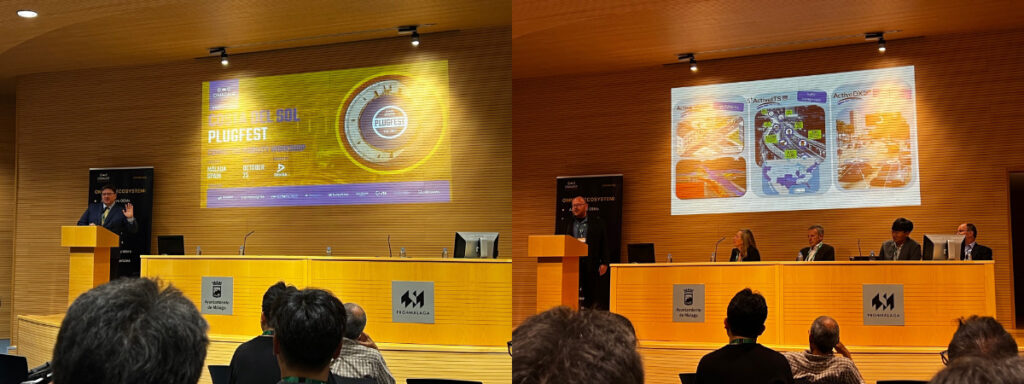
Opening ceremony of the Costa del Sol Plugfest

A wide range of bench tests were performed at the Costa del Sol Plugfest, including those involving V2X modules, message encryption, V2X-PKI certificates, SPaT message transmissions, and MAP message transmissions. Specific use cases like red light violation warning, emergency vehicle preemption, lane closure warning, curve speed warning, and many more, were tested on the field. One of the industry’s major testing and inspection firms, DEKRA, provided its testbed for the event.

As one of the more than 60 associate members of the OmniAir Consortium, and a C-ITS cybersecurity provider specialized in securing V2X connections, the AUTOCRYPT team headed to Malaga to participate in the plugfest by providing AUTOCRYPT’s SCMS certificates to the devices tested at the event.
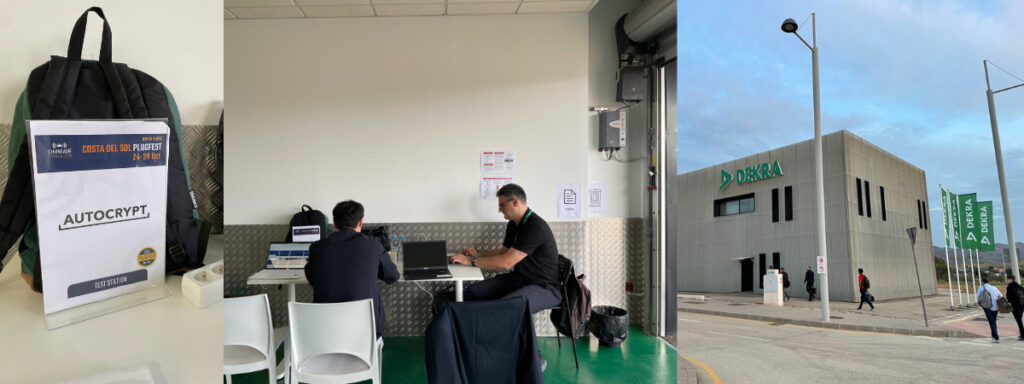
The AUTOCRYPT team testing our SCMS certificates at Dekra’s testbed

Is C-V2X Ready?

Vice President of Autocrypt North America, Martin Totev, presented at a panel session discussing whether C-V2X is ready to be deployed for commercial use. Martin expressed his optimism on C-V2X commercialization and stressed a step-by-step deployment approach. “It doesn’t need to be mass deployment and autonomous driving straight away,” said Martin. “We can begin by deploying them in vehicles first, then intersections with frequent accidents, gradually enhancing road safety and saving lives in the long run.”

Martin also pointed out the importance of cybersecurity in V2X. “Although interoperability testing is crucial, it only marks the beginning of a continuous improvement process. In fact, more commercial deployments are needed so that security and SCMS providers like AUTOCRYPT can continuously enhance its regional security policies and strengthen its definitions for misbehaviours.”

VP of Autocrypt North America, Martin Totev, speaking about C-V2X deployment

AUTOCRYPT’s Pivotal Role in the V2X Ecosystem

AUTOCRYPT specializes in securing V2X communications. Given that vehicles rely on V2X messages for judgment and decision-making, the validity of these messages is critical to the safety and functionality of cooperative autonomous driving.

AUTOCRYPT secures V2X communications using both encryption and authentication technologies. On the frontend, a security module is embedded into each end-entity to encrypt and decrypt messages by referring to a list of SCMS certificates stored in a Local Certificate Manager (LCM). At the backend, its SCMS architecture enables the proper issuance, revocation, and verification of certificates, ensuring message validity and privacy.

To learn more about AUTOCRYPT’s V2X security solutions, contact global@autocrypt.io.

To stay informed and updated on the latest news about AUTOCRYPT and mobility tech, subscribe to AUTOCRYPT’s quarterly newsletter.
Pedestrian Safety Month: How to Achieve Zero Road Fatality with V2X?

In 2020, the US Department of Transportation (DOT)’s National Highway Traffic Safety Administration (NHTSA) designated October as National Pedestrian Safety Month, celebrating the right to safety for every user of the road. The goal is to raise public awareness and strengthen efforts on improving road safety, with an emphasis on protecting vulnerable road users (VRU). VRUs include any road user that is not protected by a metal frame, such as pedestrians, cyclists, and motorcyclists.

The Current Stance of Road Safety

According to the latest statistics published by the World Health Organization (WHO), an estimated 1.3 million people across the globe die every year from road traffic incidents, with another 20 to 50 million people suffering non-fatal injuries, many of which lead to permanent disabilities.

The good news is that in most of the developed world, the number of road fatalities has seen a steady decrease over time. This pattern is especially salient in Europe; the road fatality figure of the European Union has more than halved from 51,400 deaths recorded in 2001 to 19,800 deaths in 2021. Based on the trajectory, the EU is targeting less than 11,400 annual deaths by 2030.

Beyond Europe, a similar downward trend can be seen in other developed countries like Japan, Canada, Korea, and Australia. In fact, the United States is the only country among advanced economies where road fatality saw an increase over the past decade.

This leads us to the bad news. Unfortunately—just like the United States—many parts of the world are not seeing a decrease in road fatality, meaning that the world is becoming increasingly polarized in terms of road safety. Today, 93% of the world’s road fatalities happen in less developed countries. By working with the above figures, it can be derived that road fatality in the EU only accounts for 1.5% of the global figure, despite its population representing 5.6% of world population.

Reasons for Road Traffic Accidents

To improve road safety, the best measure is to tackle the causes of traffic accidents and prevent them in the first place. To most daily drivers, operating a vehicle can feel like a subconscious task. Despite so, driving requires an intensive amount of data processing in the subconscious mind, with countless perception-judgment cycles happening every minute. One error in any of the two processes can lead to dangerous situations and potential accidents.

As expected, most errors leading to accidents are human mistakes or flaws. For instance, errors in perception can occur under low visibility, often a result of poor weather conditions or complicated terrain. Perception errors can also be caused by a lack of attention on the road due to smartphone distraction or mental stress. Similarly, judgment errors can be caused by sleep deprivation or alcohol consumption.

Oftentimes, a fatal crash isn’t the result of a driver’s error, but an error made by a vulnerable road user. For instance, a lot of road fatalities are the result of pedestrians and cyclists disobeying signals. Hence, improving road safety requires collective efforts from all road users.

Efforts to Reduce Road Traffic Accidents

By studying the potential reasons and scenarios that could result in traffic accidents, the transportation sector and the automotive industry have made a lot of preventative and protective efforts. Thanks to these efforts, many countries have managed to reduce road fatality at a steady rate.

The most significant effort is the adoption of Advanced Driver Assistance Systems (ADAS) in newer vehicles. Features like blind spot detection, lane keep assist, collision alert, and emergency braking have contributed to a great reduction in crashes. In recent years, OEMs and ADAS suppliers have further strengthened the capability of sensor and AI-based object recognition technologies to achieve a driving automation level of L2 and up to L3. Tesla’s Autopilot is one of the most marketed examples.

Other preventative measures have also been made, such as enforcing lower speed limits, increasing penalties for traffic law violations, and more spending on educating road safety to the public. Conventional protective measures have also seen great improvements, with safer airbags and vehicle structures that are better capable of absorbing crash energy.

Why Are These Efforts Not Enough?

Although ADAS adoption has demonstrated great results in reducing traffic accidents, its influence is limited to more advanced economies. Since the cost of ADAS is mostly distributed to end consumers, most consumers in low- and mid-income economies may find it too expensive to purchase a new vehicle with all the ADAS features. This explains why most of the reduction in road fatality was observed in high-income economies.

Besides being expensive, sensors have their limitations. Regardless of the amount of machine learning fed into the algorithm, in the end, sensors are just like the human eye, which must see and identify an object before making judgments. This makes sensors prone to distortion and blind spots.

Then what else can we do to achieve zero road fatality? Perhaps we can take a look at the commercial aviation industry, which has achieved zero fatality almost every year throughout the past decade. Of course, comparing road traffic with air traffic is comparing apples to oranges. Still, one thing we can learn from air traffic coordination is that it does not rely on visibility. Decisions and flight paths are determined through wireless communication.

Why Is V2X the Ultimate Answer to Achieving Zero Road Fatality?

Wireless communication for road traffic is called V2X (Vehicle-to-Everything) communication. This allows vehicles to seamlessly communicate with surrounding vehicles, road infrastructures, and even the handheld devices of vulnerable road users, to ensure that every participant on the road can receive real-time warnings and seamlessly cooperate through what is referred to as cooperative autonomous driving.

To enable V2X connectivity, a vehicle needs to be equipped with an onboard unit (OBU), while a roadside unit (RSU) needs to be installed into every relevant road infrastructure. Smartphones are also readily available V2X connectivity units, allowing vulnerable road users carrying smartphones to enroll in the V2X ecosystem. In general, V2X connectivity units are cheaper to install and deploy than ADAS, and their long-term maintenance costs are also lower.

In the short run, V2X is a great complementary measure to ADAS. Although equipping all road users and infrastructures with V2X may take decades, municipalities can begin by installing RSUs in areas with frequent accidents and areas dangerous to pedestrian safety.

By seeing the invisible and communicating information based on facts, V2X will be the ultimate answer to zero road fatality.


As an automotive cybersecurity and mobility solutions provider, AUTOCRYPT plays a crucial role in securing V2X communications. Its V2X solution is readily installable onto OBU/RSUs, consisting of a secure communication module, a PKI backend, an Integrated Management System for SCMS, along with a root CA service for the V2X-PKI ecosystem.

To learn more about AUTOCRYPT’s V2X security offerings, contact global@autocrypt.io.

To stay informed and updated on the latest news about AUTOCRYPT and mobility tech, subscribe to AUTOCRYPT’s quarterly newsletter.

AUTOCRYPT Unveils Integrated Management System for SCMS at ITS World Congress 2022

LOS ANGELES, September 29, 2022 — AUTOCRYPT, an industry-leading C-ITS cybersecurity and smart mobility solutions provider, demonstrated its newly launched Integrated Management System (IMS) for SCMS at ITS World Congress 2022 in Los Angeles. As the sole V2X security provider for all C-ITS projects in Korea, AUTOCRYPT specializes in securing V2X, in-vehicle systems, and Plug&Charge, as well as PKI systems and certificate authorization services.

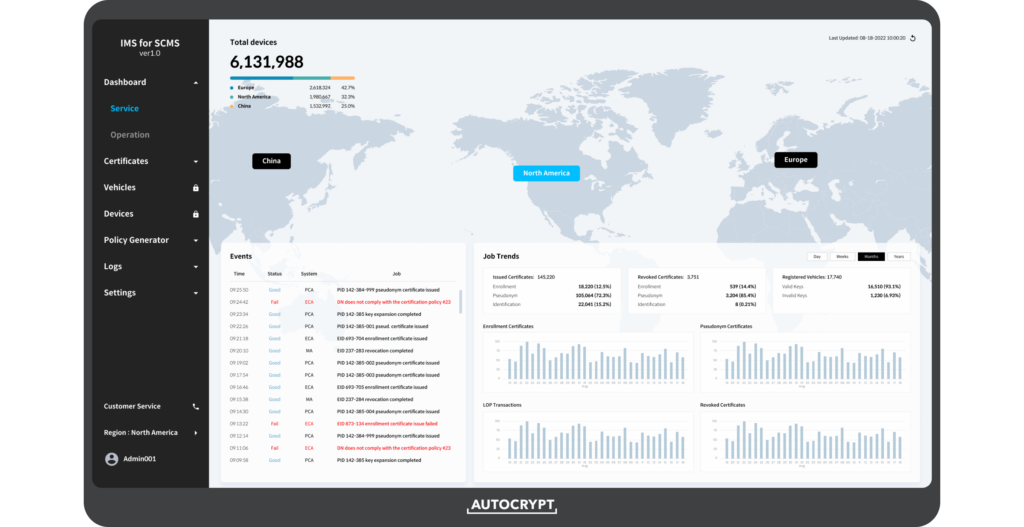
AUTOCRYPT’s IMS for SCMS is an integrated certificate management tool for the Security Credential Management System (SCMS), a PKI-based security verification system for V2X communications. IMS for SCMS enables automotive OEMs to supervise and manage all issued and revoked certificates for their vehicle fleets in real-time – across all regions – on one centralized UI.

AUTOCRYPT’s IMS for SCMS dashboard showing an overview of SCMS data in a selected region

IMS for SCMS not only provides a detailed view of all certificates and related resources, but is also equipped with automated features and services that assist with certificate management, such as system inspection and diagnostics, as well as 24/7 response for operational and technical issues. Custom-built based on the user’s needs, it is compatible with the North American SCMS, the European C-ITS CMS (CCMS), and the Chinese C-SCMS.

“At AUTOCRYPT we believe that V2X is the ultimate solution to safer transport and fully autonomous driving. One of our primary goals is to make the V2X ecosystem both secure and convenient for every party involved,” said Daniel ES Kim, CEO of AUTOCRYPT. “With the benefits of IMS for SCMS, we look forward to seeing more OEMs and infrastructure operators upscaling their V2X-enabled fleets and devices.”

Besides IMS for SCMS, AUTOCRYT’s V2X security solution includes a security module for OBUs/RSUs, V2X-PKI for road user authentication, and a root CA service that authorizes subordinate certification authorities.

To find out more about AUTOCRYPT’s V2X and automotive cybersecurity solutions, contact global@autocrypt.io.

The Evolution of Tolling and the Potentials of V2X-Based Tolling

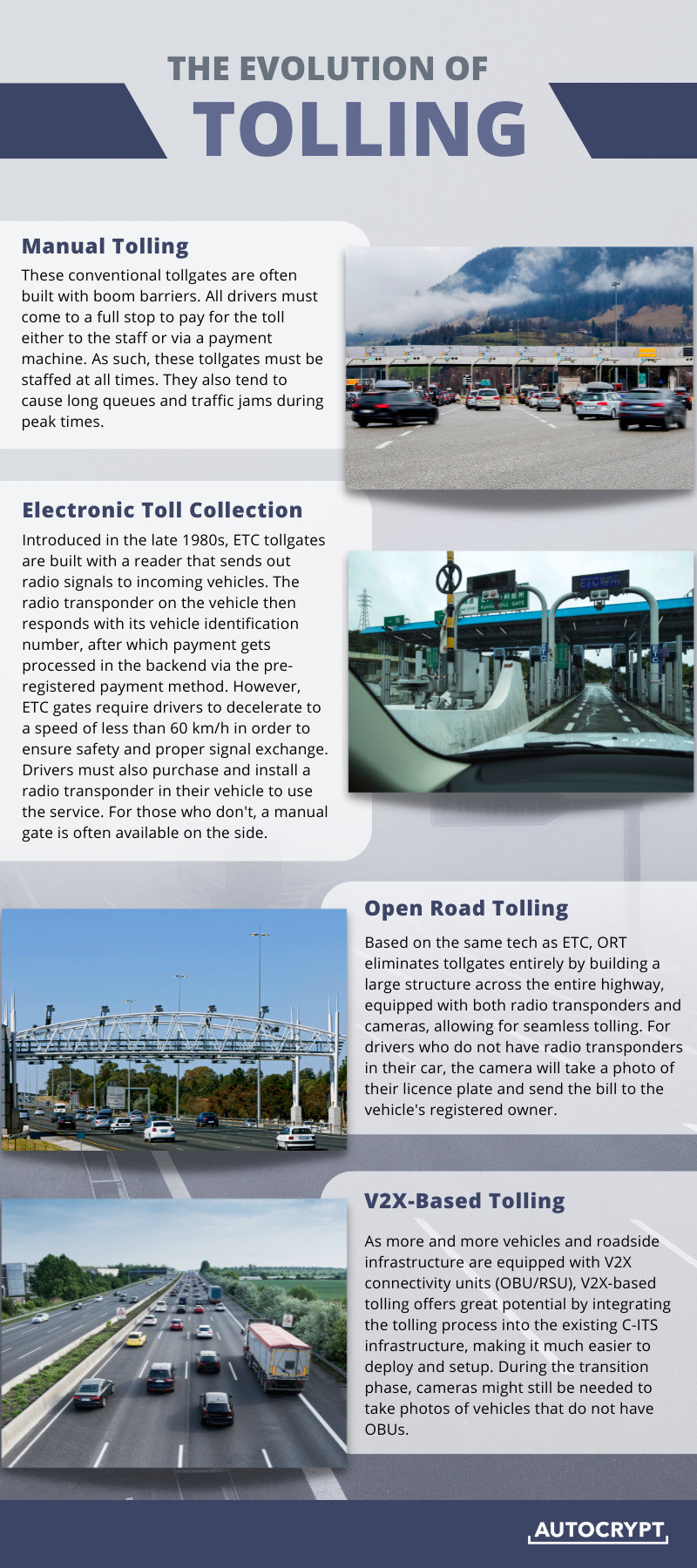
The way road tolls are collected has gone through quite an evolution. From manual tollbooths where drivers must come to a full stop to make payments — to the open road tolling (ORT) systems seen on many highways, tunnels, and bridges today, tolling has become increasingly convenient and seamless.

Speaking of a seamless driving experience, another technology that comes to mind is V2X (vehicle-to-everything), the wireless communications technology used for smart transportation. As the foundation for autonomous driving, V2X facilitates all kinds of real-time message transmissions between vehicles, infrastructure, and pedestrians. Today, as more and more vehicles and roadside infrastructure are equipped with V2X connectivity units (onboard units and roadside units), the idea of integrating tolling into the V2X ecosystem has become a hot topic.

The infographic below demonstrates how tollgates have evolved in the past, and how the path toward V2X-based tolling was paved.

The Potentials of V2X-Based Tolling

In terms of the user experience, V2X-based tolling isn’t much different from existing open road tolling systems. Then why is it worth adopting? The main reason is cost efficiency. Both ETC and ORT systems depend on radio transmission, which requires the installation of RFID readers on tollgates and radio transponders on vehicles. These devices, however, are solely made and used for tolling. On the other hand, V2X-based tolling operates on real-time communications between the onboard units (OBU) embedded in vehicles and the roadside units (RSU) embedded in road infrastructure. These devices are used for all types of communications for Vehicle-Infrastructure Cooperated Autonomous Driving (VICAD). In fact, many vehicles and smart road infrastructures today already contain OBUs and RSUs. Strictly speaking, the technology for V2X-based tolling isn’t an innovation in and of itself, but rather a readily available “byproduct” of autonomous driving development. Just like how the functionalities of MP3 players were naturally integrated into smartphones, tolling will eventually be integrated into the V2X ecosystem.


AUTOCRYPT’s Role in Securing V2X Connectivity

Since V2X communications serve a range of security-critical purposes including autonomous driving and tolling, cybersecurity systems must be pre-integrated into the communication process. With decades of experience specializing in encryption and authentication technologies, AUTOCRYPT plays a crucial role in securing V2X messages and participants, preventing unauthorized vehicle access and sensitive data exposure.

AutoCrypt® V2X is a security software package for V2X connectivity units, consisting of a software development kit (SDK) ready to be integrated into OBUs/RSUs, and a PKI-based authentication system for the secure verification of all end-entities.

To learn more about AUTOCRYPT’s V2X security offerings, contact global@autocrypt.io.

To stay informed and updated on the latest news about AUTOCRYPT and mobility tech, subscribe to AUTOCRYPT’s quarterly newsletter.

AUTOCRYPT Demonstrates PKI Interoperability and Implementations at the 3rd ETSI C-V2X Plugtests Event

MUNICH, GERMANY, April 25, 2022 — AUTOCRYPT, a leading V2X communications cybersecurity company, was the only Asian PKI provider to participate in the 3rd C-V2X Plugtests ™ interoperability testing event organized by ETSI (European Telecommunications Standards Insititute) in partnership with 5GAA at the DEKRA technology center for automobiles located in Klettwitz, Germany. The event enabled different vendors, specializing in on-board units, roadside units, and public key infrastructure, to run test sessions and assess the level of interoperability based on the latest C-ITS communications and security standards, all under the watchful eye of highway operators, automobile manufacturers, and government bodies. 

AutoCrypt V2X-PKI, a core component of the C-ITS security suite that is compliant with the standards of the US SCMS, European-based SCMS, and Chinese-based SCMS, has successfully demonstrated interoperability through various state-of-the-art safety use cases, including road hazard signaling, road works warning, time to green, in-vehicle signage, traffic jam warning, longitudinal collision risk warning, and intersection collision risk warning.  

All the tests run by AUTOCRYPT were based on ETSI’s TS sector standards, including V2X communication security and SCMS for C-ITS. The tests showed that AUTOCRYPT’s solutions accomplished high levels of interoperability with other companies that are actively engaging in the development of C-V2X for the automotive industry. Through this inspection and supplementation, AUTOCRYPT expects to develop pilot projects led by the European governments and equipment companies within the year. 

Daniel ES Kim, CEO of Autocrypt Technologies GmbH, said: “It was an honor for AUTOCRYPT to be one of the selected companies at the 3rd C-V2X Plugtests ™. As V2X communications usage in the automotive industry continues to increase and PKI plays a central role in its secure development, it is critical that we continue to strengthen our SCMS management capabilities through various interoperability tests across the globe. The successful demonstration of our PKI solutions means that we are continuing to lead the industry and ensure a safer, more reliable environment to support our users.” 

AUTOCRYPT will continue to raise the standards in the PKI sector and will be demonstrating its new V2X capabilities at the highly anticipated ITF 2022 Summit this coming May. This year’s International Transport Forum will convene various experts across industries and governments to share insights on enabling social inclusion through utilizing innovative technologies in transport while promoting sustainable economic growth.  

As the deployment of applications using PKI continues to increase, AUTOCRYPT looks forward to bringing new fully customizable products and solutions to market for the benefit and safety of the industry, passengers, and the public.

Protecting Vulnerable Road Users (VRU) With V2P Technology

Vulnerable road user (VRU) is a term used to describe any road user who is not inside a motor vehicle. This can mean a pedestrian, a cyclist (or motorcyclist), a scooterist, or someone in a wheelchair. Compared to motorists, VRUs are much more likely to suffer from severe injuries or death in a traffic accident due to their lack of external protection. Although vehicle-pedestrian crashes are much less common than vehicle-vehicle crashes, these accidents still contribute to a significant number of road fatalities. According to the Insurance Institute for Highway Safety (IIHS), pedestrian fatalities account for 17% of all casualties from traffic accidents, while cyclist fatalities account for another 2%.

Why Are VRU Fatalities Increasing?

During the past decade, we have seen significant improvements in Advanced Driver-Assistance Systems (ADAS), including features like pedestrian detection and warning. This gives us an intuition that VRU safety must have been improving. Shockingly, a completely opposite trend was observed. Pedestrian fatalities have in fact increased by 51% over the past ten years, most of which occurred in urban areas.

Given all the technological advancements, why isn’t the pedestrian fatality rate falling? One possible explanation is the growing popularity of SUVs, which are taller than sedans and more likely to hit the pedestrian’s upper body in crashes. Another likely cause is that both drivers and pedestrians today face constant smartphone distraction, making them less focused and attentive on the road.

The Struggles to Keep VRUs Safe

Over the past few years, urban planners and policymakers have been implementing progressive approaches to improve VRU safety by either eliminating roadways in crowded urban centers or reducing the speed limit to less than 30 km/h in city streets. However, these countermeasures are only effective in cities with a well-established public transit system that can handle a drastic increase in passengers. For many cities that rely heavily on personal vehicles, implementing such measures can be quite disruptive and inefficient for daily commuters.

Protecting VRUs isn’t about sacrificing one group for the other. It is essentially about protecting everyone, as every driver technically becomes a VRU the moment they exit the car. Hence, finding a balanced solution that benefits both motorists and VRUs is crucial. In this regard, V2P technology shows great potential. V2P (vehicle-to-pedestrian) technology is a sub-type of V2X (vehicle-to-everything) communications technology that allows vehicles to communicate with pedestrians in real-time wirelessly. With V2P, vehicles and pedestrians will be able to cooperate seamlessly on the road to prevent accidents.

How Does V2P Differ From V2V and V2I?

V2P operates under the same mechanism as other types of V2X communications like V2V (vehicle-to-vehicle) and V2I (vehicle-to-infrastructure). However, there are some unique aspects of V2P that make its deployment and application somewhat different from the other two.

Installation

To enable any V2X communication, a V2X connectivity unit must be installed on every end entity of the ecosystem. An end entity can be a vehicle, a traffic signal, a roadside camera, and many more. The V2X connectivity units can either be embedded within the end entities during the manufacturing process or externally connected to existing vehicles and infrastructure that do not have embedded units.

However, we cannot simply install V2X connectivity units on unpowered V2P entities like bicycles, scooters, skateboards, wheelchairs, and of course, the human body. In this case, smartphones can act as end entities. A compact and lightweight portable V2X device can be plugged into the mobile devices of VRUs so that they can easily participate in V2P communications. These portable V2X devices are extremely versatile and can be plugged anytime into all kinds of smart devices such as phones, tablets, and vehicle head units via common ports like USB-C.

Another potential deployment method relies on a specific type of V2X mode—the C-V2X Uu interface. Different from the PC5 interface—which enables end entities to communicate directly with each other without going through any medium—the Uu interface sends all messages through the mobile broadband spectrum, connecting all entities to the cellular network. Under this mode, all smart devices with cellular connectivity become readily available V2X connectivity units with no need for external hardware.

Application

Whereas V2V and V2I communications are used to serve the purpose of vehicle-infrastructure cooperated autonomous driving (VICAD), V2P adds VRU cooperation to the mix, taking autonomous driving to the next level. By doing so, it further enhances the safety of autonomous driving in urban areas by complementing conventional ADAS and pedestrian warning systems. In application, vehicles receive the real-time location, speed, and direction of every VRU in their surroundings, allowing them to respond immediately to all kinds of unexpected behaviours.

On the other hand, V2P can also be used to issue warning messages to pedestrians. Many observational studies have pointed out the severity of pedestrian smartphone distraction. One study in Melbourne found that 20% of all walkers were on their smartphones while crossing the road. These “smartphone zombies” are at a significantly higher risk of traffic accidents. With V2P-enabled smartphones, these walkers can be alarmed at traffic signals and pedestrian crossings.


Better Autonomous Driving Starts from Road User Cooperation

Even though most developments in autonomous driving have been focusing on V2V and V2I applications, we should not forget that vehicles are not the only road users. To make autonomous driving smarter and safer, more participants should be invited to join the ecosystem. Adding VRUs to the cooperated autonomous driving mix has the potential to greatly reduce vehicle-VRU accidents and improve road safety and efficiency in urban areas.

AUTOCRYPT is actively working on developing technologies that accelerate V2P deployment. To stay informed and updated on the latest news about AUTOCRYPT and mobility tech, subscribe to AUTOCRYPT’s quarterly newsletter.

To learn more about AUTOCRYPT’s mobility service solutions, contact global@autocrypt.io.