AUTOCRYPT, a leading automotive and AI cybersecurity solutions provider, announced at CES 2026 the launch of “Automotive-CIS (Cybersecurity Infrastructure Standard),” presenting a new global benchmark for vehicle cybersecurity infrastructure to the international technology community.
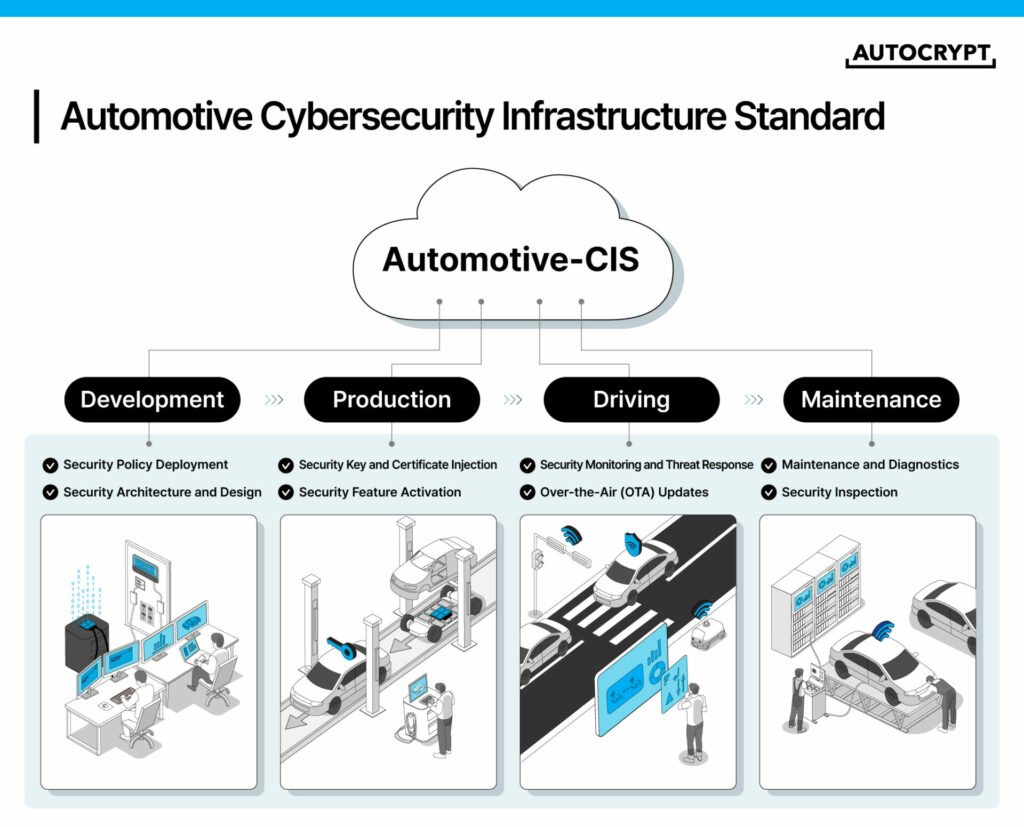
Automotive-CIS is an advanced and expanded version of Autocrypt’s Software Security Infrastructure solution previously delivered to automotive manufacturers (OEMs). The new standard broadens its scope to include suppliers and establishes an integrated security architecture spanning the entire vehicle software lifecycle from development and production, all the way to driving and maintenance.
By integrating key functions like the Cybersecurity Management System (CSMS), Software Update Management System (SUMS), Vehicle Security Operations Center (vSOC), and Threat Analysis and Risk Assessment (TARA) into a single infrastructure standard, Automotive-CIS provides a core reference model for OEMs and suppliers as the industry shifts to software-defined vehicles (SDVs) and AI-driven mobility.
Autocrypt’s extensive proof-of-concept (PoC) projects with both domestic and international OEMs and suppliers have served as a foundation for the global vehicle cybersecurity standard, shown through inclusion of tailored deployment roadmaps, expert consulting, and comprehensive regulatory compliance strategies across the supply chain.
CEO and co-Founder, Seokwoo Lee remarked on the unveiling, “Automotive-CIS represents the essential foundations necessary for this new era of SDVs, AI mobility, and post-quantum computing.” He continued, “We are delighted to present this at CES 2026, as it provides OEMs and suppliers with an opportunity to collaboratively address evolving security challenges across the vehicle lifecycle.”
Autocrypt is currently showing its solutions at CES 2026, in Las Vegas from January 6-9. Visitors are welcome at the Las Vegas Convention Center, West Hall Booth #4667. Meetings are available on-site, by reservation only. Book a meeting at https://calendly.com/autocrypt_global/. To learn more, visit autocrypt.io.
About Autocrypt Co., Ltd.
AUTOCRYPT is the leading player in automotive cybersecurity. It specializes in the development and integration of security software and solutions for in-vehicle systems, V2X communications, Plug&Charge, and fleet management, paving the way towards a secure and reliable C-ITS ecosystem in the age of software-defined vehicles. Its comprehensive suite of automotive cybersecurity testing services and platforms includes the award-winning AutoCrypt CSTP, which supports automotive OEMs and suppliers in meeting regulatory standards ilke ISO/SAE 21434, UNECE WP.29 UN R155, and CRA.
Public transportation is undergoing a profound transformation.What was once limited by fixed timetables and rigid infrastructure is evolving into an intelligent, adaptive network powered by real-time data,electrification and automation. Beyond technological progress, this shift reflects a move toward a mobility model driven by cooperation and shared innovation.
Cities, governments, and transport authorities are increasingly co–developing mobility services with private technology providers to address emerging urban and societal needs. Many of these efforts are guided and supported by national and bilateral innovation initiatives, providing the funding and regulatory frameworks needed to connect public governance with private technological capability.
This blog highlights the global trend through initiative-backed examples, showing how collaboration between public entities and private firmsis reshaping the future of public transportation.
Rise of Adaptive Public Mobility Ecosystems
Traditional fixed-route transit systems are increasingly challenged by uneven ridership patterns, with dense urban areas often overcrowded while suburban and rural regions remain underserved. To close this gap, cities and transport authorities are adopting digitally integrated, AI-poweredsystems that can adjust dynamically to real-time demand, ensuring more efficient and inclusive operations.
The following case studies illustrate how initiative-backed partnerships are aligning public governance with private innovation, advancing adaptive, data-driven mobility solutions through the combined expertise of governments and technology leaders.
Case 1: Shucle DRT Pilot (Hungary, 2025)
The Hyundai Shucle pilot in Hungary was launched under the Economic Innovation Partnership Program (EIPP), a Korea-Hungary bilateral cooperation framework led by the Ministry of Economy and Finance (MOEF) and the Korea Development Institute (KDI). Under the initiative’s design on promoting innovation-driven development projects, the pilot aims to introduce an AI-powered Demand-Responsive Transport (DRT) solution which enhances operational efficiency and accessibility within Hungary’s public transit systems.
On the public side, MOEF and KDIoversee funding, policy design and program monitoring, while the Gödöllő Municipality and local transport operatorsact as pilot hosts, integrating the service into the local transit network. As the private partner, Hyundai Motor Groupprovides and operates the Shucle platform, which leverages AI for dynamic routing, real-time demand optimization and fleet management.
The project demonstrates how bilateral innovation programs can effectively bridge public governance and private technology to deliver tangible mobility improvements.
Case 2: NoWel4Project (Germany, 2024-2026)
The NoWel4Project originates from Germany’s FederalMinistryfor Digital and Transport (BMDV) R&D programforAutonomous and ConnectedDriving. The initiativefocusesondeployingLevel 4 autonomouselectricshuttlesinnorthwest Berlinto explore howautomatedmobilitycanbeintegratedsafely and effectivelyintoexistingpublictransportnetworks.
BVG, Berlin’s public transport operator, manages route planning, service integration and regulatory compliance, while academic and institutional partners, including TU Berlin and IKEM, contribute to research and policy framework development. The private partner, MOIA GmbH, a subsidiary of Volkswagen Group, provides and operatesID.Buzz AD shuttles equipped with Level 4 automation and oversees software management, connectivity and fleet operations.
Together, the partners representGermany’s coordinated approach to incorporating advanced automation within the public transport ecosystem.
Case 3: National Diet Shuttle (Japan, 2025)
In a more recent case, TIER IV was selected to lead a public-sector autonomous shuttle project connecting government buildings around Japan’s National Diet in central Tokyo. Funded by the Ministry of Economy, Trade and Industry (METI), the initiative aims to accelerate the adoption of autonomous driving technologies within public services, addressing broader social challenges such as an aging populations and driver shortages in municipalities beyond major metropolitan areas.
Powered by Autoware™, the open-source autonomous driving software developed by TIER IV, the system utilizes Suzuki’s Solio model and implements TIER IV’s robotaxi reference design. The service began operations on November 20, 2025, with project findings expected to inform Japan’s future frameworks for autonomous mobility procurement and deployment.
This example illustrates Japan’s commitment to technology-driven public innovation, embedding autonomous mobility into public infrastructure to enhance transportation efficiency while advancing social sustainability.
Case 4: Autonomous Shuttle Pilot (Singapore, 2025)
In Singapore, the partnership between WeRideand Graboperates under the Land Transport Authority (LTA)’s regulatory sandbox for autonomous vehicle testing, part of the nation’s Smart Nation and Land Transport Master Plan. Under a framework that enables real-world testing of autonomous mobility technologiesin designated smart zones, the pilot conducts large-scale trials of autonomous shuttles in Singapore’s Punggol district to evaluate service readiness before public launch in early 2026.
Guided by the LTA, which ensures compliance with national safety and operational standards, the pilot brings together two private partners, each contributing distinct technical and operational strengths. WeRide, serving as the technology provider, supplies autonomous driving systems and vehicles while managing fleet operations and safety monitoring. Grab, leveraging its operational and local expertise, handles service deployment, customer interface, and integration with its existing ride-hailing platform.
This initiative stands to illustrate a regulatory-sandbox approach where public oversight and private innovation intersect to validate autonomous mobility services for commercial deployment.
Implications
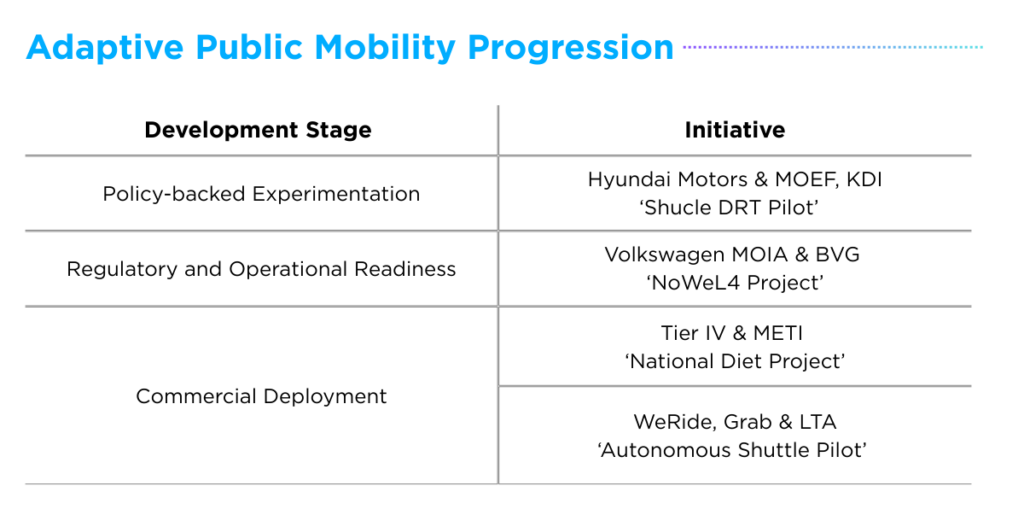
Despite regional and strategic variations, the four cases trace a clear progression in how adaptive public mobility is evolving through public-private collaboration.
The ‘Shucle DRT Pilot’ demonstrates how bilateral innovation programs can initiate policy-backed experiments that connect governance with technology. Building on this foundation, both the ‘NoWel4 Project’ and ‘National Diet Project’ exemplify how coordinated public initiatives are advancing regulatory and operational readiness for autonomous urban transit. Finally, the ‘Autonomous Shuttle’ pilot highlights the transition from controlled testing to commercial deployment, illustrating how proven technologies can scale into real-world, revenue-generating services.
Together, they pursue the same overarching goal: to enhance accessibility, efficiency and adaptability within public transportation systems and highlight a global shifttoward an adaptive mobilityframework.
Future of Connected Mobility
As cities worldwide adopt adaptive mobility frameworks, their success increasingly depends on secure, interoperable collaboration between public and private stakeholders. Ensuring seamless communication among vehicles, infrastructure, and digital platforms requires standardized protocols, trusted data exchange and end-to-end cybersecurity. Without these foundations, the integration of connected and autonomous mobility remains incomplete.
AUTOCRYPT plays a defining role in enabling this transformation. In particular, AutoCrypt® MOVE™ (Learn More) is one such solution which shows our capabilities into the mobility platform domain. Designed for demand-responsive transport (DRT) and other emerging mobility services, AutoCrypt® MOVE™ enables operators to plan, deploy and manage secure, data-driven mobility platforms tailored to diverse needs.
By combining our proven expertise in fleet management, data analytics, and security integration, AUTOCRYPT supports both public transit operators and private mobility providers in establishing reliable and adaptive services.
With expertise spanning digital key management, V2X communication, cybersecurity testing and compliance consulting, AUTOCRYPT provides the technologies and guidance that help stakeholders operate securely within complex mobility environments. By embedding safety and interoperability into every layer of mobility infrastructure, AUTOCRYPT helps build a trusted, scalable, future-ready ecosystem which benefits both public and private partnerships.
The rise of artificial intelligence is signaling disruption in the technology industry. The likes of Microsoft, Google, and OpenAI are spearheading fierce competition to create the most advanced artificial intelligence aimed at improving the way we interact with technology. While intelligent language models like ChatGPT are already fascinating people with their abilities to deliver answers to given prompts, AI technologies currently available to the public are just the tip of the iceberg. In the automotive industry, artificial intelligence can streamline operations and improve efficiency throughout the supply chain. Utilization of artificial intelligence in the automotive cybersecurity sector can especially benefit threat detection and response.
The Need for Strengthened Vehicle Cybersecurity
Several decades ago vehicle security would entail door locks, car alarms, and airbags. While the same is still true, cybersecurity is becoming an essential part of automotive security. Ensuring full protection now includes shielding the vehicle from internal system malfunctions as well as external cyber threats. However, as cars turn more software-driven and connected, vehicle security is becoming increasingly complex.
A modern-day car contains multiple electronic control units (ECUs) responsible for in-vehicle electronic systems that regulate and perform various functions ranging from essential tasks like steering and engine control to more mundane ones like unlocking doors and rolling down windows. The number of ECUs in a given vehicle depends on the quantity and complexity of vehicle features. For instance, a contemporary luxury car can have up to 150 ECUs, and the number may continue growing if new functionalities and sub-systems are added. These ECUs communicate with different parts of the vehicle and other ECUs to keep the vehicle running. Each of these ECUs and their communication nodes must be secured to protect the vehicle from cyber threats.
Limitations of Conventional Automotive Cybersecurity
Keyless car theft, infotainment system attacks, malware, conventional automotive cybersecurity software is built to protect against these and many other known threats. Cybersecurity companies employ ethical hacking methods to ensure the timely discovery of system loopholes. In ethical hacking, white hat hackers are responsible for hacking vehicle systems to find weaknesses in the software and report it to the cybersecurity software developers, who then implement appropriate security measures.
The complex system architecture of modern vehicles contains dozens of ECUs and millions of code lines, all of which can be potentially exploited by malicious actors. Manually searching for vulnerabilities in these vehicles is like looking for a needle in a haystack. As vehicle systems get more complex securing them will become even harder. While ethical hacking helps companies develop resilient security measures against cyber attacks, this ad hoc approach to cybersecurity has its limitations.
The biggest challenge in automotive cybersecurity is protecting the vehicle from unprecedented danger, also known as a zero-day attack. These attacks exploit previously undiscovered vulnerabilities in vehicle systems to install malware or tamper with the vehicle. Protection against zero-day attacks necessitates a more sophisticated approach to automotive cybersecurity, which is where AI comes in.
The Potential of AI/ML-powered Cybersecurity
AI/ML-based systems analyze, classify, and train on large amounts of data to self-improve and make independent decisions down the road. When applied in automotive cybersecurity, machine learning algorithms can be implemented in the security software to learn common patterns of vehicle operations. A trained model will then be able to distinguish anomalies that fall beyond the scope of ordinary vehicle signals. If malicious behavior is detected the cybersecurity software will send alerts and shield the vehicle from danger. Even if a malicious actor exploits a previously unidentified vulnerability, an AI-powered anomaly detection model will be able to detect intrusions and prevent them.
A car’s digital communications are simple and more predictable than that of a typical computer network. Since signals exchanged during normal vehicle operations often follow fixed patterns, determining an anomalous signal is not very difficult. Therefore, employing unsupervised machine learning in cybersecurity is feasible. For instance, imagine a car driving on the highway at cruising speed that suddenly receives a breaking signal requesting to stop the car in the middle of the road. An AI-powered security software will be able to differentiate this unusual command from a common driving pattern. The system will then block the anomalous signal and send it over to the security experts for further action.
While perfecting a fully AI-based cybersecurity software may take years, some companies are already leveraging the power of machine learning in their solutions. One example is AutoCrypt Security Fuzzer, which is an automated testing solution that employs an AI-based algorithm to input semi-random test cases into selected systems to reveal errors in vehicle software. The solution essentially causes intentional crashes in the system to expose software vulnerabilities that need to be addressed. An AI-based security fuzzer greatly reduces testing time, streamlining the ad hoc approach to cybersecurity implementation.
Due to the self-improving nature of artificial intelligence, the potential of AI in automotive cybersecurity is limitless. The speed of developments in the automotive sector requires cybersecurity measures that are just as agile. Leveraging artificial intelligence in vehicle cybersecurity will help address the risks of zero-day attacks and mitigate threats in a timely and efficient manner.
To stay informed and updated on the latest news about AUTOCRYPT and automotive cybersecurity, subscribe to AUTOCRYPT’s official newsletter.
This website uses cookies so that we can provide you with the best user experience possible. Cookie information is stored in your browser and performs functions such as recognising you when you return to our website and helping our team to understand which sections of the website you find most interesting and useful.
Strictly Necessary Cookies
Strictly Necessary Cookie should be enabled at all times so that we can save your preferences for cookie settings.
If you disable this cookie, we will not be able to save your preferences. This means that every time you visit this website you will need to enable or disable cookies again.
3rd Party Cookies
This website uses Google Analytics to collect anonymous information such as the number of visitors to the site, and the most popular pages.
Keeping this cookie enabled helps us to improve our website.
Please enable Strictly Necessary Cookies first so that we can save your preferences!