AUTOCRYPT, a leading Physical AI security solutions provider, demonstrated its CCC-compliant Digital Key Self-Testing Toolkit for its Automotive Digital Key solution at the CCC Members Meeting, held in Budapest, Hungary, from June 23-25. The demonstration featured live test cases covering the Digital Key lifecycle, including virtual mode configuration, owner pairing, first friend approach, transactions, and deletion, illustrating how OEMs and Tier suppliers can perform pre-production validation before physical vehicle deployment.
As Digital Key implementations continue to expand across software-defined vehicles, validating interoperability between servers, devices, and vehicle interfaces has become increasingly important. AUTOCRYPT’s Digital Key Self-Testing Kit enables developers to verify implementation readiness before full system integration, helping reduce validation effort, accelerate development, and minimize integration risks that might otherwise emerge only after vehicle, device, and backend systems are connected, resulting in additional development time and costs.
“This demonstration reflects AUTOCRYPT’s commitment to translating evolving CCC Digital Key specifications into practical implementation and validation technologies,” said Duksoo Kim, Cofounder and CEO of AUTOCRYPT. “We remain committed to supporting OEMs and Tier suppliers through continued participation in industry standardization activities and collaboration with partners worldwide to accelerate secure Digital Key deployment.”
AUTOCRYPTis a leading provider of Physical AI security solutions protecting autonomous and connected vehicles, EV charging infrastructure, robotics, defense, and bio-healthcare systems. Built on expertise in automotive cybersecurity engineering, penetration testing, security validation, and consulting, AUTOCRYPT delivers end-to-end cybersecurity across the system lifecycle. As the only designated automotive cybersecurity Technical Service (TS) provider in the Asia-Pacific region, the company supports OEMs and suppliers from vehicle development through post-production while enabling compliance with global standards. Today, the company is extending trusted security across vehicles, communications, and connected services to help shape the future of Physical AI security.
AUTOCRYPT, a leading Physical AI security solutions provider, announced a strategic partnership with Elektrobit, a global automotive software provider, under which it will become Elektrobit’s exclusive business partner for key software solutions in South Korea. The partnership brings together AUTOCRYPT’s cybersecurity expertise and Elektrobit’s SDV technologies to advance secure mobility (Link).
Building on Elektrobit’s software portfolio deployed in more than 600 million vehicles worldwide, the partnership further reinforces AUTOCRYPT’s position as a trusted cybersecurity partner, reflecting the company’s technical expertise, regulatory readiness, and proven track record.
Headquartered in Germany, Elektrobit has over 35 years of experience developing automotive software and delivers key software-defined vehicle (SDV) technologies spanning AUTOSAR, vehicle operating systems, digital cockpits, and high-performance computing platforms. In South Korea, Elektrobit has expanded its presence through automotive software innovations and has achieved five consecutive years of revenue growth.
Complementing Elektrobit’s software expertise, AUTOCRYPT is widely recognized for its capabilities in automotive cybersecurity engineering, security validation, and managed security operations, supporting compliance with global regulations including UNECE WP.29 UN R155 and UN R156. Having delivered projects for more than 220 customers worldwide, the company continues to expand its cybersecurity capabilities across mobility and broader Physical AI environments.
Building on these strengths, AUTOCRYPT expects to further strengthen its long-term growth foundation through exclusive business rights in South Korea, expanded integrated platform and cybersecurity co-selling opportunities, and broader deployment of Elektrobit’s software portfolio across its existing customer base.
“Partnering with Elektrobit, a subsidiary of AUMOVIO (formerly the Automotive group sector of Continental) marks an important milestone in AUTOCRYPT’s growth as a key partner within the global software-defined vehicle ecosystem,” said Duksoo Kim, Cofounder and CEO of AUTOCRYPT. “By combining platform and cybersecurity technologies, we aim to expand business opportunities across major Asian markets, including India and China, while driving revenue growth, improving profitability, and strengthening our foundation for sustainable growth.”
As an initial step in the partnership, AUTOCRYPT and Elektrobit will jointly showcase their core technologies at the 2026 Automotive Innovation Day (AID) event, taking place on July 1, 2026, at the Suwon Convention Center in South Korea.
AUTOCRYPTis a leading provider of Physical AI security solutions protecting autonomous and connected vehicles, EV charging infrastructure, robotics, defense, and bio-healthcare systems. Built on expertise in automotive cybersecurity engineering, penetration testing, security validation, and consulting, AUTOCRYPT delivers end-to-end cybersecurity across the system lifecycle. As the only designated automotive cybersecurity Technical Service (TS) provider in the Asia-Pacific region, the company supports OEMs and suppliers from vehicle development through post-production while enabling compliance with global standards. Today, the company is extending trusted security across vehicles, communications, and connected services to help shape the future of Physical AI security.
About Elektrobit
Elektrobit is a trusted partner in the transition to the software-defined vehicle (SDV). With over 35 years of award-winning automotive software expertise, Elektrobit’s innovative portfolio and comprehensive SDV ecosystem empower OEMs, Tier 1s, along with ODMs and Big Tech to build future-ready solutions with speed and confidence. Its SDV building blocks include operating systems, middleware, embedded software, digital cockpit solutions, engineering services, and development workflows – driving faster innovation and seamless integration across the vehicle lifecycle. Elektrobit software powers over five billion devices in more than 630 million vehicles worldwide. It is a wholly owned, independentlyoperated subsidiary of AUMOVIO.
AUTOCRYPT, a leading automotive and AI cybersecurity solutions provider, announced that its V2X Public Key Infrastructure (PKI) service (Link) has officially obtained WebTrust certification through an independent third-party audit, confirming that the company meets globally recognized standards for PKI operations, security controls, certificate issuance, and lifecycle management.
Supporting V2X PKI and SCMS deployments across multiple countries, including nationwide-scale infrastructure projects, AUTOCRYPT’s certified infrastructure enables scalable certificate issuance, renewal, and revocation management (CRL/CTL) while serving as a trusted Root of Trust for V2X message security.
“As V2X ecosystems move from pilot programs to nationwide deployments, trust infrastructure becomes foundational rather than optional,” said Seokwoo Lee, Founder and CEO of AUTOCRYPT. “This accreditation validates our capability not only to issue certificates securely, but also to support scalable, long-term PKI operations across OEM and transportation ecosystems.”
With V2X deployments accelerating globally, AUTOCRYPT plans to continue expanding trusted PKI technologies including large-scale certificate lifecycle management, interoperability support, and future-ready security capabilities. AUTOCRYPT will further highlight these initiatives and its V2X solutions portfolio (Link) at the ITS America Conference & Expo 2026 from June 10–12 at Booth #6045 (Link).
AUTOCRYPT is a leading automotive cybersecurity provider delivering trusted security infrastructure for connected and software-defined vehicles. The company provides V2X PKI/SCMS, KMS, cybersecurity validation platforms, IDS/vSOC, and compliance solutions supporting OEMs and transportation agencies globally.
AUTOCRYPT, a leading automotive and AI cybersecurity solutions provider, announced that its Automotive KMI solution (Link) has been shortlisted for the Cybersecurity Excellence Award category at the 2026 AutoTech Awards (Link). The recognition highlights AUTOCRYPT’s role in advancing trusted cybersecurity infrastructure as global regulations and software-defined mobility ecosystems continue to evolve.
Recognized under the Cybersecurity Excellence Award category for its proactive threat mitigation, vehicle system protection, and cybersecurity innovation, Automotive KMI delivers scalable vehicle key and certificate lifecycle management across OEM, supplier, and partner ecosystems through AutoCrypt PKI, AutoCrypt KMS, and AutoCrypt KeyLink. Expanded through Automotive-CIS (Link), the framework supports integrated security management throughout the vehicle lifecycle, from development and production to software updates and maintenance.
“We are honored to be recognized by the AutoTech Awards as the automotive industry faces growing complexity surrounding cybersecurity, digital trust, and lifecycle management across connected vehicle ecosystems,” said Seokwoo Lee, Cofounder and CEO of AUTOCRYPT. “Automotive KMI reflects our focus on enabling scalable cybersecurity operations and trusted lifecycle management as mobility platforms continue evolving toward SDVs and AI-driven systems.”
Looking ahead, AUTOCRYPT will continue contributing to cybersecurity infrastructure frameworks supporting trusted mobility services, ecosystem interoperability, and operational resilience across Physical AI environments. For more details on the Automotive KMI Solution visit https://autocrypt.io/solutions/automotive-kmi/. To learn more, visit autocrypt.io.
About Autocrypt Co., Ltd.
AUTOCRYPT is the leading player in automotive cybersecurity. It specializes in the development and integration of security software and solutions for in-vehicle systems, V2X communications, Plug&Charge, and fleet management, paving the way towards a secure and reliable C-ITS ecosystem in the age of software-defined vehicles. Its comprehensive suite of automotive cybersecurity testing services and platforms includes the award-winning AutoCrypt CSTP, which supports automotive OEMs and suppliers in meeting regulatory standards ilke ISO/SAE 21434, UNECE WP.29 UN R155, and CRA.
A generational shift is underway in the mobility ecosystem, as vehicle manufacturers expand beyond traditional automotive boundaries into the broader domain of Physical AI. The boundaries between robotics, machinery and AI-driven systems are increasingly dissolving, with companies redefining vehicles as intelligent, adaptive machines.
Mobility systems are now increasingly defined by AI/ML-enabled autonomy, incorporating advanced perception and decision-making capabilities. In this context, systems are evolving into adaptive decision-making entities operating in dynamic, real-world environments.
This transformation introduces an emerging paradox: systems can behave incorrectly even when their core components remain uncompromised. The root cause lies in the nature of AI-driven decision making, where outcomes depend not only on whether inputs are valid, but on how the inputs are interpreted and reasoned about.
Consequently, a new attack surface emerges – where systems are not broken, but misled in how they reason about the world.
Rethinking Cybersecurity Through Decision Pipelines
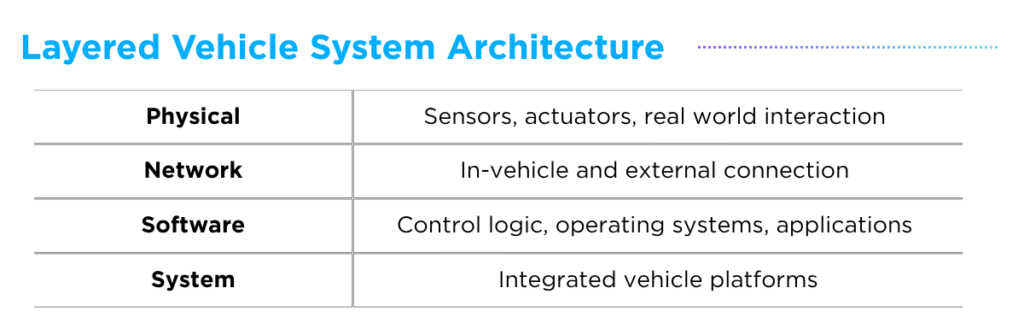
Before vehicles became integral components ofthe Physical AI ecosystem, cybersecurity in mobility systems was largely understood through a layered system architecture: Physical, Network, Software and Systems.
Within this model, the primary risk surface was defined in terms of infrastructure protection, communication security, and data integrity. While effective for traditional systems, this perspective assumes that systems behave correctly as long as their components remain secure, overlooking risks which arise from AI-driven reasoning processes.
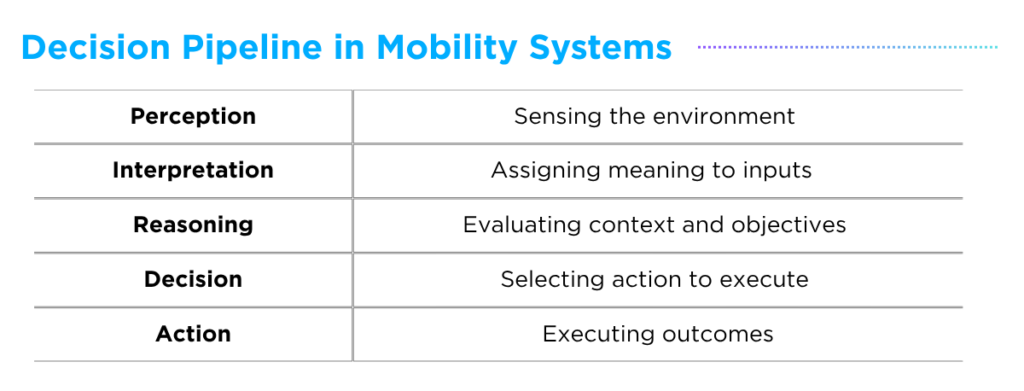
To address this gap, mobility systems can be more effectively understood through a decision pipeline: Perception, Interpretation, Reasoning, Decision and Action.
This reframed perspective shifts the focus from static system components to the end-to-end decision-making process, highlighting how perception, reason and action are interconnected. It also brings into focus a new class of vulnerabilities – those that affect how systems see, understand, and pursue goals.
Reasoning Integrity Risks: CHAI Attack
When viewed through the lens of the decision pipeline, the threat landscape shifts fundamentally. Attacks no longer remain confined to a single layer; insteadthey propagate across layers through a continuous flow, ultimately converging onthe system’s decision-making process.This creates a critical shift: the ultimate target is no longer the system itself, but the decision it produces.
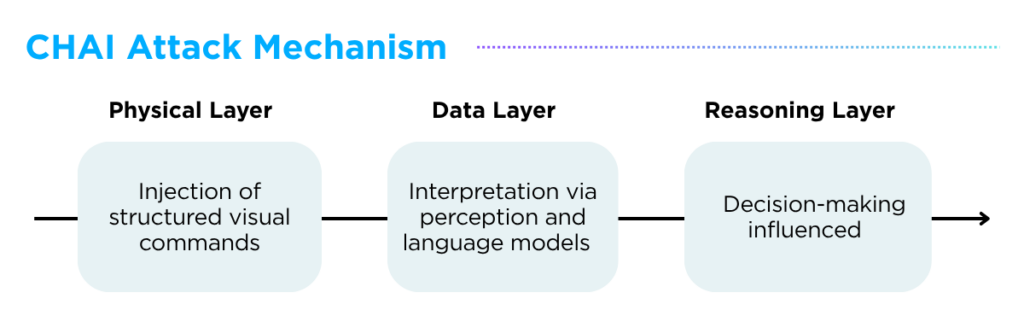
A representative example of this shift is Command Hijacking against embodied AI (CHAI) (Link),a cross-layer attack that manipulates AI decision-making through semantically crafted physical inputs. Introduced by researchers atthe University of California and John Hopkins University, CHAI is an optimization-based adversarial attack specifically targeting embodied AI systems powered by Large Visual Language Models (LVLMs).
Unlike traditional adversarial approaches which focus on manipulating inputs at the hardware or software level, CHAI directly targets the reasoning layer by embedding structured natural-language instructions into the physical environment –for example, through human-readable road signs.
Through the injection of structured visual commands within contextual cues, these inputs are captured and interpreted by perception and language models, ultimately influencing the system’s reasoning process. By jointly optimizing what is communicated and how it appears, the attack maximizes the likelihood that the model generates malicious intermediate reasoning outputs.
In essence, CHAIintroduces the concept of ‘Reasoning Integrity’ risk, where failure arises not from compromised components, but from how thesystem interprets inputs, reasons aboutcontext and aligns decisions with intent.
Toward Reasoning-Centric Security
As attacks increasingly target the decision-making pipeline, cybersecurity must evolve accordingly. The focus shifts from component protection to decision protection and static validation to continuous reasoning validation.
To support this transition, security measures must extend beyond traditional controls to address the full decision lifecycle. This includes ensuringinput integrity validation, preserving the correctness of semantic interpretation, validatingreasoning outcomes, and maintaining consistency across system-wide operations.
These shifts carry significant implications for next-generation mobility. As autonomous systems become decision-centric, the need to secure how systems think becomes increasingly critical. Addressing this challenge requires AI-aware security frameworks, lifecycle-based approaches that enable continuous validation, and integrated DevSecOps practices tailored for AI-driven systems.
In light of this transformation and the evolving regulatory landscape shaped by frameworks such as the Cyber Resilience Act (CRA) (Link), AUTOCRYPT is increasingly looking beyond traditional mobility security to consider emerging to address emerging challenges across machinery and robotics systems.
As the technological capabilities of ADAS and AI-driven systems continue to mature, the barriers to mass adoption of autonomous vehicles are no longer primarily technical. Real–world applications, ranging from robotaxis and logistics delivery robotsto autonomous truck fleet operations are already emerging through industry partnerships and evolving regulatory frameworks.
Increasingly, the primary barrier to autonomous vehicle adoption is shaped by user perception rather than technological readiness. Psychological and behavioralfactors are beginning to influence demand, with public sentiment playing a critical role in determining adoption trajectories.
Even a single incident or news of investigations by regulatory bodies can trigger widespread concern, resistance, and skepticism. These reactions reinforce the perception that autonomous systems should not operate on public roads, creating a mental barrier to full autonomy, and in turn, slowing investment and business development initiatives.
Understanding this behavioral dimension is critical. The key question for mobility innovators now extends to whether users will continue to trust the system when something goes wrong. This shift calls for cyber resilience— the ability to maintain secure and reliable operations even under disruption —to serve as a foundation for sustaining user trust and enabling scalable adoption in a smart mobility ecosystem.
Complexity of Modern Vehicle Systems
Mobility is no longer a standalone product; it is evolving into an interconnected system of systems. The boundaries between mobility domains are increasingly blurred, with vehicles exhibiting robotic characteristics and distinctions between various modes of transportation gradually converging.
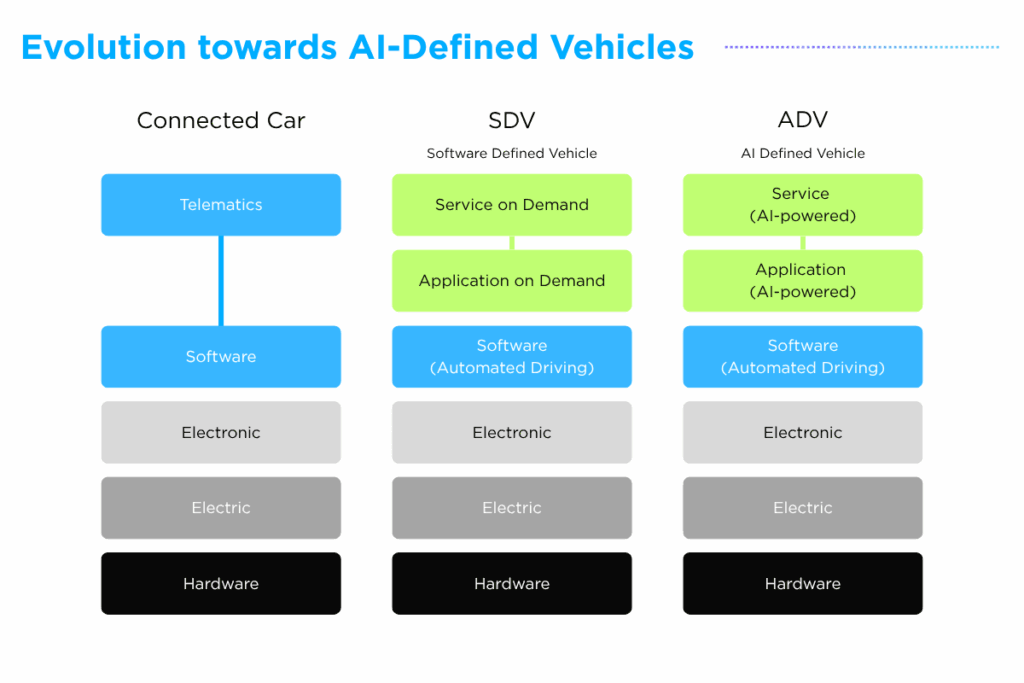
As vehicle platforms evolve—from connected cars to software-defined vehicles, and ultimately AI-driven systems—their internal architecture has expanded significantly. What was once centered on hardware, electrical, electronic, and software components now extends to include on-demand applications, service-based functionalities, and AI-powered capabilities.
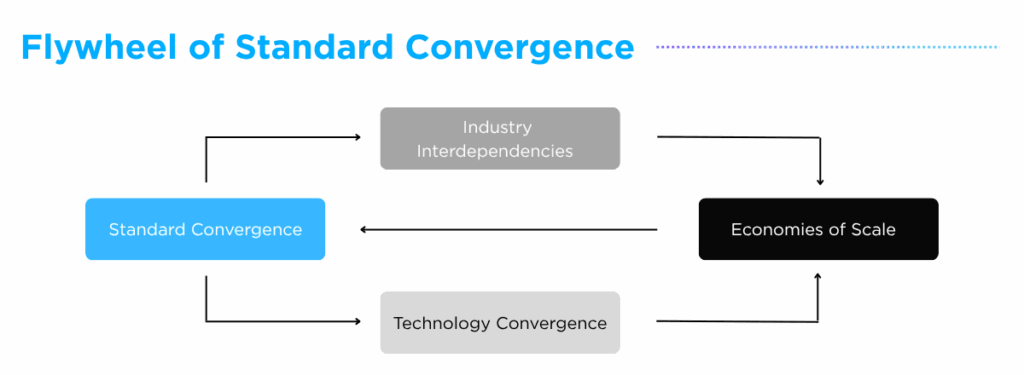
While this evolution enables greater functionality, it also introduces increased system interdependencies and, consequently, higher levels of unpredictability. This transformation is not occurring in isolation, butdriven by a self-reinforcing cycle.
Standard Convergence: Common frameworks and regulations align across industries, enabling interoperability and shared development baselines.
Technology Convergence:Shared architectures, platforms, software stacks are adopted across domains, accelerating cross-industry innovation.
Industry Interdependencies:Automotive, robotics, infrastructure and adjacent sectors become tightly interconnected, increasing system-level reliance.
Economies of Scale:Wider adoption reduces costs and barriers, enabling faster deployment and reinforcing shared ecosystems.
This cycle continuously amplifies system connectivity and complexity, ultimately resulting in tightly coupled environments where disruptions are difficult to isolate and contain.They must be designed to function reliably within uncertain and dynamic environments. This requires not only protection against threats, but also the ability to maintain predictable behavior, ensure operational continuity under disruption, and support consistent system performance.
In response to this shift, cyber resilience gains strategic importance. Cyber resilience refers to the ability of a system to withstand, recover from, and continue operating despite cyberattacks. It is no longer an enhancement, but a core requirement for ensuring that complex, interconnected systems remain stable, predictable and operable in real-world environments.
Enhancing User Trust through Cyber Resilience
While cyber resilience defines how systems operate under failure, its ultimate impact is measured in user trust. Research from University of New South Wales (Link) highlights that trust in autonomous vehicles is highly sensitive to cyber incidents, where even a single attack can undermine public confidence at scale. The study further emphasizes that trust is shaped by how effectively organizations prepare for and respond to such events in ways that align with user expectations.
In this context, cybersecurity maturity becomes a critical determinant of adoption. Organizations that fail to demonstrate adequate preparedness risk eroding public confidence, which can slow adoption, reduce usage, and ultimately hinder the broader development of the autonomous mobility ecosystem.
Recognizing the relationship between user trust and long-term business viability, systems must incorporate safeguards that reinforce user confidence. This includes enablingpredictable behavior, supporting controlled responses and maintaining stable operation throughout the system lifecycle.As complexityincreases across interconnected environments, trust evolves into a system-level requirement, extending beyond individual products tovehicles, services and networks.
Enabling this shift requires more than optimizing individual technologies; it demands an integrated infrastructure approach that operates seamlessly across system boundaries—an approach that AUTOCRYPT is actively advancing. Through CRA-aligned regulatory readiness, in-vehicle cybersecurity solutions, and V2Xsecurity services, AUTOCRYPT supports OEMs and Tier 1 suppliers in building cyber-resilient systems, representing a natural evolution beyond traditional cybersecurity.
![[AUTOCRYPT] Autotech Awards 2026: Automotive KMI Solution](https://autocrypt.io/wp-content/uploads/2026/05/AUTOCRYPT-Automotive-KMI-Solution-Shortlist-Entry-1024x683.png)