AUTOCRYPT Gains Attention at CES 2024 with Vehicle Fuzzing Solution, CSRO Wins SDV Innovator Awards

LAS VEGAS, Jan. 11, 2024 — Automotive cybersecurity and mobility solutions company AUTOCRYPT showcased its embedded systems and V2X security solutions for software-defined vehicles (SDV) at CES 2024, gaining attention with its smart fuzzing solution dedicated to automotive protocols.

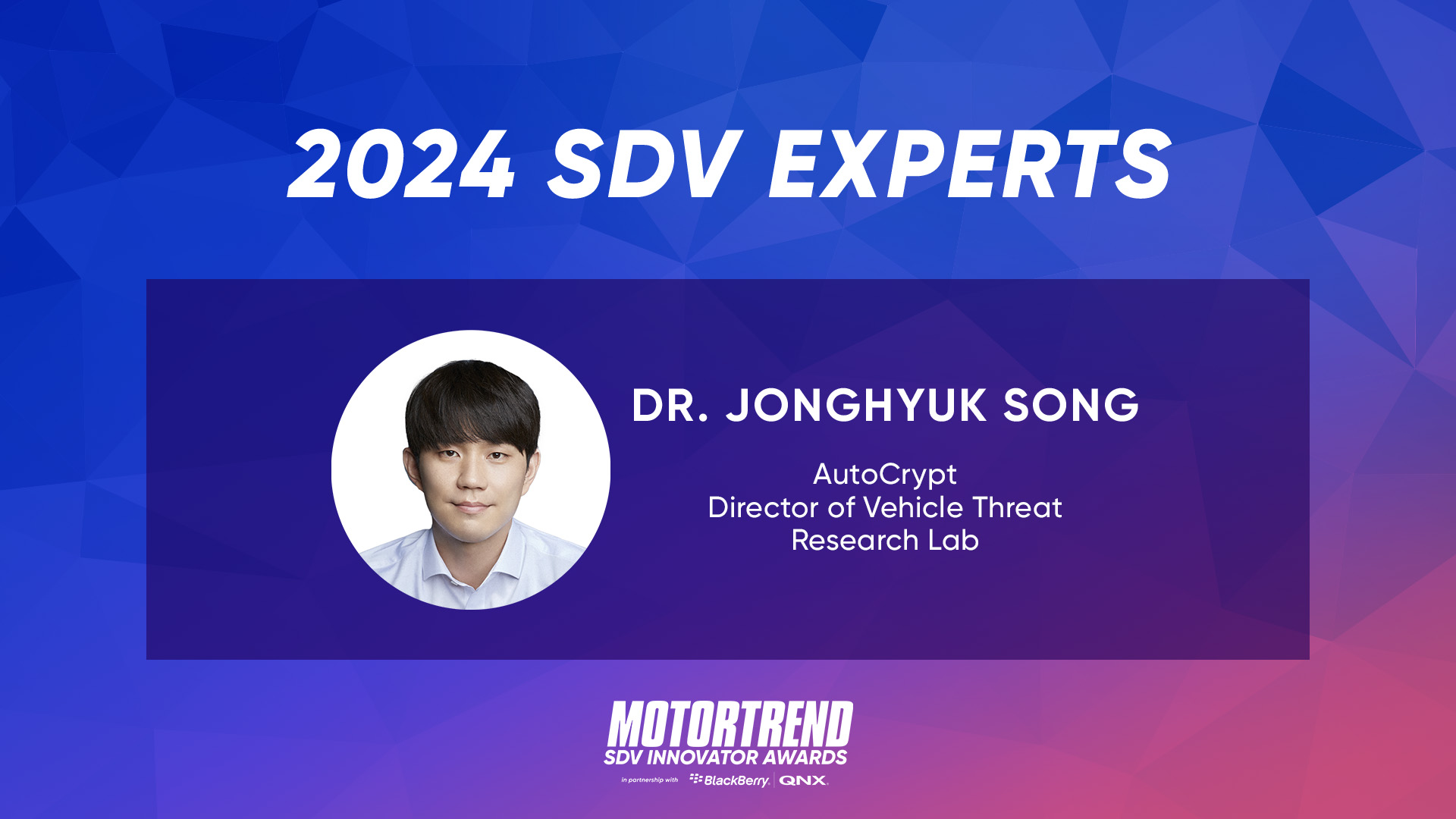
AUTOCRYPT’s capability in vehicle fuzzing is also recognized by industry professionals. On the evening of the event’s opening day, AUTOCRYPT’s Chief Security Research Officer (CSRO), Dr. Jonghyuk Song, was announced winner in the “Experts” category of the 2024 MotorTrend SDV Innovator Awards, recognized for his groundbreaking research and leadership at AUTOCRYPT.

As Director of AUTOCRYPT’s Vehicle Threat Research Lab, Dr. Song has led the lab into developing one of the world’s first fuzzing tools designed for vehicular protocols, including UDS, CAN, Wi-Fi, Bluetooth LE, and the Ethernet. This differentiates AutoCrypt Security Fuzzer from conventional fuzz testers, allowing it to detect vulnerabilities at exceptionally high accuracy with much lower time consumption.

Throughout 2023, the VTR Lab has also collaborated with RWTH Aachen University to develop AutoCrypt Security Fuzzer for HIL, enabling fuzzing in hardware-in-the-loop (HIL) simulations. The team also conducts regular offensive security testing on vehicle ECUs, and is recognized by major manufacturers as experts in ethical hacking.

“The goal of the VTR Lab is to improve the effectiveness and efficiency of vehicle testing within and beyond the established framework of UN R155 and ISO/SAE 21434,” said Dr. Song. “I’m honored to be recognized – it allows for more attention and focus on the need for cybersecurity for software-defined vehicles. Ultimately, we want to help OEMs and suppliers eliminate such risks and bring safe, secure mobility for all road users.”

About Autocrypt Co., Ltd.

AUTOCRYPT is the leading player in automotive cybersecurity and smart mobility technologies. It specializes in the development and integration of security software and solutions for in-vehicle systems, V2X communications, Plug&Charge, and fleet management, paving the way towards a secure and reliable C-ITS ecosystem in the age of software-defined vehicles. AUTOCRYPT also provides management and service platforms for the operators and end users of MaaS, contributing to sustainable and universal mobility.

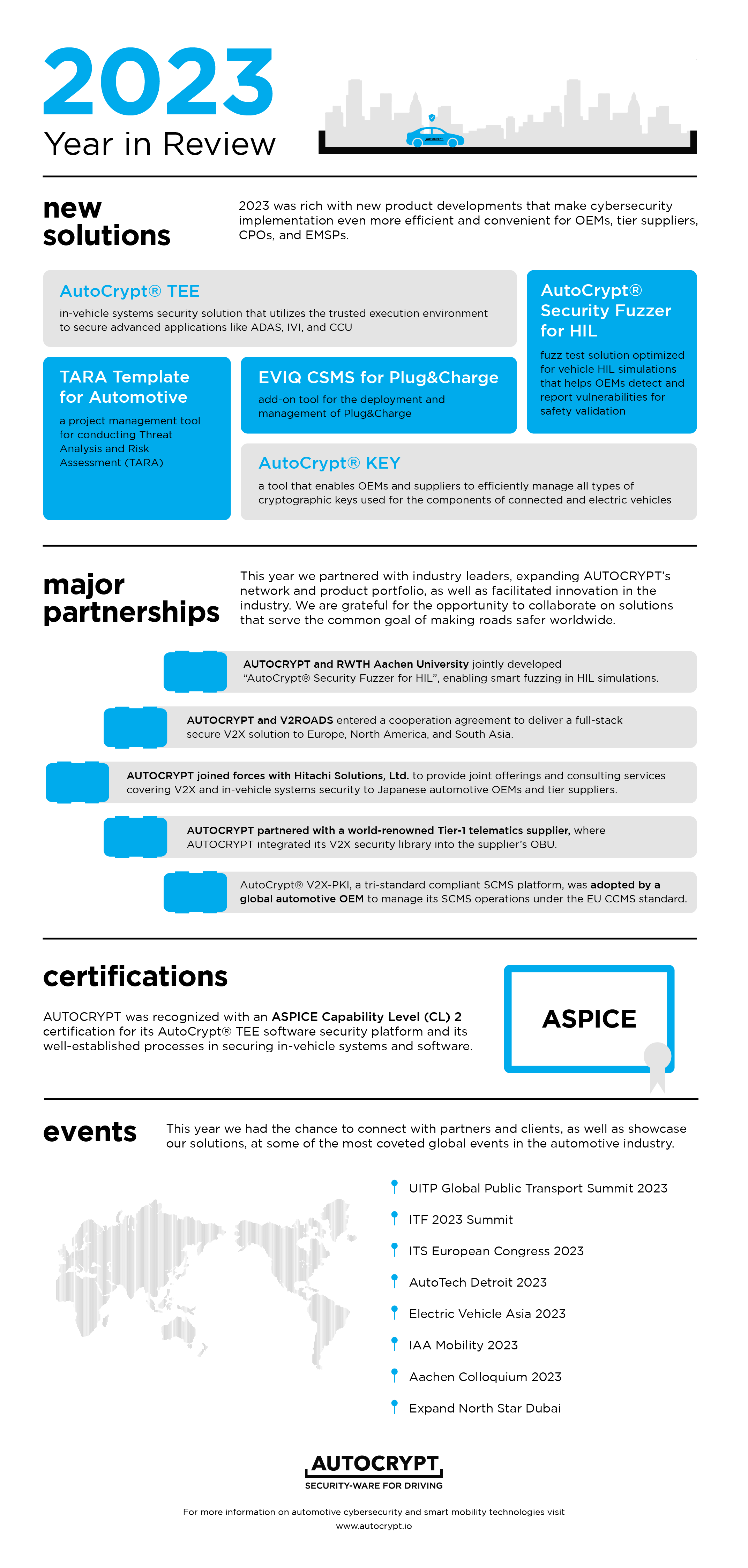
Infographic: 2023 Year in Review

This year was full of innovation and exciting new partnerships. We want to thank our investors, partners, clients, readers, and visitors for your support in 2023. We are looking forward to what 2024 will bring!

Have a Happy New Year !

See below for a summary of AUTOCRYPT’s accomplishments in 2023.

Download PDF

(Accessibility version below)

New solutions:

AutoCrypt TEE – an ASPICE CL2-certified in-vehicle systems security solution that utilizes the trusted execution environment to secure advanced applications like ADAS, IVI, and CCU

AutoCrypt Security Fuzzer for HIL  – an add-on version to the existing Security Fuzzer, the “AutoCrypt Security Fuzzer for HIL” is fuzz test solution optimized for vehicle HIL simulations that helps OEMs detect and report vulnerabilities for safety validation

“TARA Template for Automotive” – a project management tool for conducting Threat Analysis and Risk Assessment (TARA), a process crucial to the development and maintenance of automotive software

EVIQ CSMS for Plug&Charge an add-on tool that will seamlessly guide the deployment and management of Plug&Charge operations, available for charge point operators and e-mobility service providers

AutoCrypt KEY – a tool that enables OEMs and suppliers to efficiently manage all types of cryptographic keys used for the components of connected and electric vehicles. AutoCrypt KEY provides all the key management features needed for automotive production

Major partnerships:

AUTOCRYPT and RWTH Aachen University jointly developed “AutoCrypt Security Fuzzer for HIL”, enabling smart fuzzing in HIL simulations.

AUTOCRYPT and V2ROADS entered a cooperation agreement to deliver a full-stack secure V2X solution to Europe, North America, and South Asia.

AUTOCRYPT joined forces with Hitachi Solutions, Ltd. to provide joint offerings and consulting services covering V2X and in-vehicle systems security to Japanese automotive OEMs and tier suppliers.

AUTOCRYPT partnered with a world-renowned Tier-1 telematics supplier, where AUTOCRYPT integrated its V2X security library into the supplier’s OBU.

AutoCrypt V2X-PKI, a tri-standard compliant SCMS platform, was adopted by a global automotive OEM to manage its SCMS operations under the EU CCMS standard.

Certificates:

ASPICE → AUTOCRYPT was recognized with an ASPICE Capability Level (CL) 2 certification for its AutoCrypt TEE software security platform and its well-established processes in securing in-vehicle systems and software.

Events:

This year we had the chance to connect with partners and clients, as well as showcase our solutions, at some of the most coveted global events in automotive industry.

  • UITP Global Public Transport Summit 2023
  • ITF 2023 Summit
  • ITS European Congress 2023
  • AutoTech Detroit 2023
  • Electric Vehicle Asia 2023
  • IAA Mobility 2023
  • Aachen Colloquium 2023
  • Expand North Star Dubai

5 Futuristic In-Vehicle Infotainment Features in the Age of Software-Defined Vehicles

The automotive landscape is in the midst of a profound transformation. Cars have now entered the realm of digitization, where the competition isn’t solely about design and horsepower, but also the ingenuity of digital features. To keep up, original equipment manufacturers (OEMs) are diversifying their offerings, introducing features that offer a more futuristic and personalized driving experience.

At the heart of this revolution lies in-vehicle infotainment (IVI), an integrated vehicle system merging entertainment and information delivery for drivers and passengers. Its overarching objective is to amplify the driving experience, keeping occupants informed, entertained, and safe. This blog will unveil five of the most cutting-edge vehicle infotainment features flourishing in the automotive sector today. 

AI and Voice Assistants 

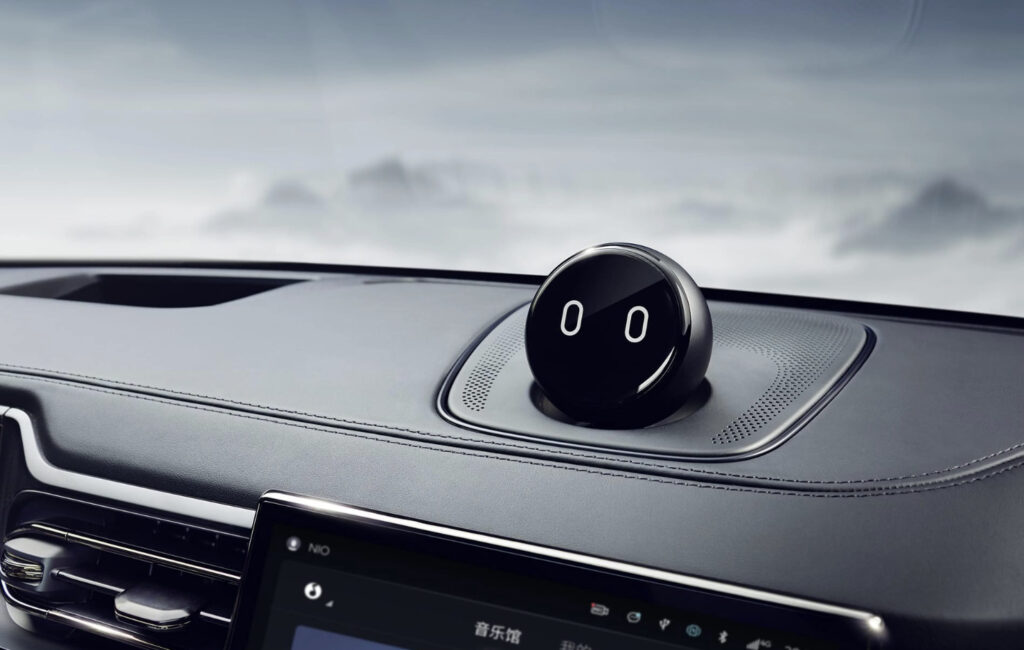
The buzz surrounding artificial intelligence has seeped into the automotive domain, with OEMs dedicating colossal R&D investments to create the most advanced automotive AI. While primarily utilized for autonomous driving, AI’s applications extend far beyond. Recent car models feature AI assistants integrated into the vehicle’s infotainment system. These assistants boast advanced language processing, biometrics, and deep learning abilities, enabling them to do an array of different tasks that make the driver’s life easier. These tasks include, but are not limited to, ordering groceries en route, planning trip routes with charging stops, and even orchestrating various vehicle functions.  

Integrating GPTs into AI assistants takes the technology a step further. Unlike conventional voice assistants tethered to predefined tasks, GPTs leverage a vast language model, enhancing its natural language understanding and expanding its abilities as a smart-car assistant. The likes of Mercedes-Benz are utilizing the technology to create AI assistants that act like smart, conversational companions, curating an engaging driving ecosystem. 

NIO in-vehicle infotainment AI voice assistant

Facial Recognition

While cameras within car structures aren’t novel, their application has undergone a significant expansion. Coupled with advanced processing capabilities, new in-vehicle cameras facilitate facial recognition features that multiply infotainment system capabilities. Vehicle cameras now monitor driver behavior, detecting blinking rates and yawning to signal potential fatigue. With the rapid development of driving assistance, features like this are employed as safety measures to make sure the driver does not lose concentration or doze off behind the wheel.  

On top of safety, facial recognition enables seamless vehicle unlocking and authorization for payments through the infotainment system. We can see that common smartphone features are making their way into vehicles as customers expect more convenience and digitization from their cars. Pioneering Chinese car models delve deeper, employing facial recognition for experience personalization. For instance, the futuristic XPENG G3 allows users to select their preferred seat positioning and lighting settings, and uses face recognition to then adjust to personalized settings based on who is at the driver’s seat. 

Gesture Control

Gesture recognition technology, available in select premium vehicles, has transformed the way drivers interact with their cars. This innovation extends beyond the conventional realm of in-vehicle infotainment, introducing an intuitive interface that responds to simple hand gestures. Gesture recognition lets you use a subtle swipe to adjust volume, a flick of the wrist to change music tracks, or a pinch in the air to zoom in on navigation maps. The integration of gesture control not only enhances convenience but also represents a significant leap in fostering a safer driving environment. By minimizing manual distractions, drivers can effortlessly navigate the car’s interface without diverting their gaze from the road, enjoying both convenience and safety. 

Moreover, the ongoing evolution of gesture control technology envisions a future where these intuitive motions go beyond the entertainment realm. Soon, drivers might be able to execute more complex commands with a wave of the hand, accessing vehicle diagnostics, or even initiating communication functions. This paradigm shift in interaction within the vehicle is reshaping the traditional dashboard layout, signaling an era where physical buttons and knobs might gradually become obsolete. 

Unique Entertainment Options 

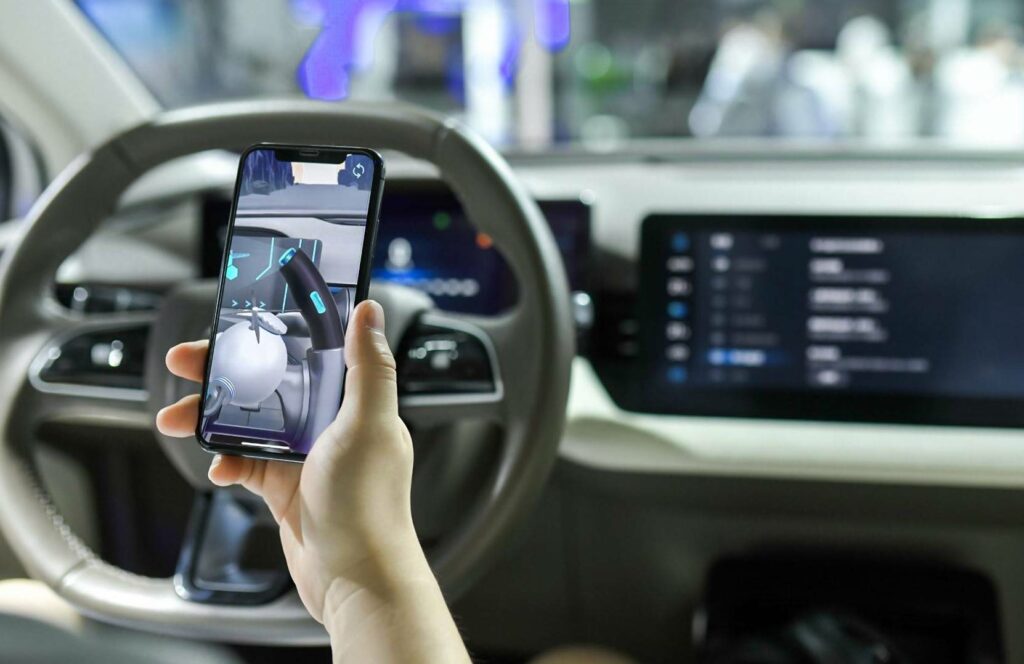
Automakers are revolutionizing the automotive landscape by crafting distinctive entertainment features to captivate the attention of younger audiences. The range of entertainment offerings is expanding rapidly with some models offering in-car gaming tools, built-in karaoke systems with wireless microphones, augmented reality (AR) and voice tech utilizing interactive user manuals. These pioneering features not only set these vehicles apart from competitors but also redefine the very purpose of a vehicle beyond mere transportation. And as self-driving becomes more widespread, consumers will make purchasing decisions based on the in-car experience, so these entertainment options will become increasingly important. 

AIWAYS in-vehicle infotainment interactive car manual

Dashboard App Diversification 

The digital transformation of vehicles has created an urgent demand for personalization, prompting manufacturers to reimagine the dashboard as a customizable canvas. Thanks to over-the-air systems, vehicle users can now curate their dashboard by downloading applications right into their infotainment systems.  

Seamlessly integrating social media feeds, news updates, or productivity tools directly into the vehicle’s dashboard, modern cars not only cater to individual preferences but also pave the way for an ever-evolving ecosystem within the vehicle, where the driving experience transcends transportation, becoming an extension of one’s lifestyle and interests. This synergy between technology and personalization is revolutionizing the way users interact with their vehicles, morphing cars into smart devices tailored to customer needs. 

Securing the Future of Automotive Innovation 

The evolution of in-vehicle infotainment into a realm of advanced AI integration, facial recognition, gesture control, and diversified dashboard apps marks a seismic shift in automotive technology.  

As cars become digital hubs of connectivity and convenience, the significance of safeguarding these systems against potential cyber threats cannot be overstated. Each innovative feature, while enhancing personalization and convenience, also presents entry points for malicious exploitation. The industry’s focus on robust cybersecurity measures—encryption protocols, intrusion detection, and collaborative standards—are crucial in fortifying these high-tech infotainment features against unauthorized access and exploitation. 

The future of driving isn’t solely about technological sensation, it’s about responsible innovation. Protecting the integrity, privacy, and safety of these advanced infotainment systems is a shared responsibility of all industry participants. 

AUTOCRYPT’s in-vehicle cybersecurity solutions provide complete protection for the vehicle-embedded systems minimizing cybersecurity risks, while facilitating safe and responsible innovation in the industry. 

To stay informed about the latest news on mobility tech and automotive cybersecurity, subscribe to AUTOCRYPT’s monthly newsletter.  

Exploring the Future of Mobility: What is a Software-Defined Vehicle?

In recent years, the automotive industry has been abuzz with the term “software-defined vehicle” (SDV). With an increasing number of original equipment manufacturers (OEMs) claiming to be at the forefront of SDV development, it’s essential to understand what truly makes a vehicle software-defined. In this blog post, we will delve into the concept of SDVs, their current state of development, and the industry trajectory for the future. 

The Ultimate SDV: What Does It Entail? 

Before we dive into the ultimate vision for SDVs, it’s crucial to recognize that modern vehicles already incorporate various software-defined features like in-vehicle infotainment, driver assistance systems, and cellular connectivity technologies. These features are adding advanced capabilities to our vehicles, digitizing the way we interact with our cars and improving the driving experience. However, they do not represent the final destination of SDV technology. 

The ultimate SDV is a vehicle that has undergone a profound transformation in its design and functionality. It is not just about adding software-enabled features, it’s about making software the central nervous system of the vehicle.  

An SDV’s value lies primarily in the software that enables advanced capabilities like cloud connectivity and autonomous driving. And while the hardware is still important, software will be the differentiating factor in new generation SDVs. Software maintenance and upgrading will be the most economical, convenient, and efficient way for future OEMs to provide a differentiated product and improve customer satisfaction. OEMs are spending countless resources on R&D to make this possible. 

The ultimate software-defined vehicle is a supercomputer vehicle that supports increased flexibility, customization, and remote upgradeability of functionalities.  

A crucial element that enables this level of flexibility in SDVs is cloud connectivity which powers over-the-air (OTA) software downloads and updates. Vehicle-cloud connectivity has the potential to significantly cut back costs for new software rollouts, as new functionalities can be introduced over-the-air without the need to alter underlying hardware.  

Besides development cost savings, OTA software implementation can create monetary value in the face of software subscription models for OEMs. We have already seen this phenomenon rise in the industry with the likes of Tesla offering subscription-based functionalities, like full self-driving, to its customers. 

The goal of the industry is to reach a point where vehicle software and hardware development can be done independently from each other. This will require the entire industry to embrace innovation and shift away from the traditional vehicle manufacturing process. 

Necessary Technology for SDVs 

Emphasizing the role of software in a vehicle will require separating vehicle software from its hardware. Achieving complete software and hardware decoupling requires a fundamental shift in vehicle architecture and supply chain operations.  

Traditionally, Tier 2 electronic control unit (ECU) manufacturers embed software within the hardware. This limits OEMs from implementing software changes down the road. The decoupling of software from hardware would allow the vehicle software to operate independently, similar to a smartphone. Applications can be downloaded from the app store and updated OTA. 

In addition, complete software-hardware decoupling has the potential to significantly accelerate software development times. This enables scaled and continuous software improvement across a vehicle’s serviceable life, all while incurring lower development costs.  

Reaching decoupling will take a complete reshuffling of the current distributed electrical/electronic (E/E) vehicle architecture into a centralized system defined by a central computing unit. This cardinal change is needed due to the fact that a distributed vehicle architecture cannot keep up with the increasingly higher computing power needed for SDVs. On the other hand, if a car has 100 ECUs, all of these ECUs would have different embedded software that could be based on completely different platforms. This makes software implementation very difficult, if not impossible.  

Centralizing vehicle electronics simplifies management and allows for more efficient software integration. The development of a centralized architecture would allow OEMs to implement software updates directly to the central processing unit, which is exponentially more time and cost-efficient. It will also encourage OEMs to utilize standardized or open-source software platforms for SDVs. This shift will allow for higher system integration within the vehicle and functions like high-speed connectivity to the cloud, other vehicles, and smart infrastructure. 

Moreover, open-source software is gaining traction in the automotive sector. Open-source software platforms provide a collaborative environment for developers to contribute to SDV technology, accelerating innovation. 

Current State and Future Trajectory 

The entire automotive industry is currently in the midst of the transformation towards software-defined vehicles. Normally, Tier 2 component suppliers, who are in charge of embedding software within their chips, do not have direct contact with OEMs and have to go through Tier 1 suppliers. However, nowadays we are witnessing a seismic shift in supply chain operations signified by a demand for software suppliers. Tier 2 and pure-play software developers are gaining a stronger position within the supply chain, indicating a shift towards prioritizing software expertise. As the automotive industry is going through a technological shakeout, the supply chain is also turning more horizontal, allowing for less restricted relations between supply chain participants. 

Furthermore, there is a rising trend of industry collaboration as automakers realize the complexity and scale of SDV development. We have seen some of the largest traditional OEMs welcome partnerships with technological companies. Stark examples are partnerships between Qualcomm and Mercedes-Benz, BMW and Amazon, BYD and Baidu, where automakers are turning to tech companies to spearhead SDV development.  

Cross-industry partnership is showing that the automotive sector is ready to stir away from tradition in the name of innovation.  

Regulations and Standards 

As the SDV landscape evolves faster than ever, regulations and standards play a crucial role in ensuring vehicle safety and security. The United Nations UNECE WP.29 set out two regulations for vehicle type approval. UN R155 addresses vehicle type approval with a focus on cybersecurity and cybersecurity management systems, and UN R156 mandates secure software updates and implementation of software update management systems. 

These regulations enforce software-defined vehicle development that is secure by design. UN R155 mandates that cybersecurity principles are implemented at the core of business processes, vehicle architecture design, risk assessment, and security control implementation. This means that cybersecurity regulations are implemented throughout the entire supply chain.  

While these regulations are legally binding for the countries that have signed the agreement, ISO/SAE 21434 serves as an international standard for road vehicle cybersecurity engineering. Companies may choose to adhere to this standard voluntarily. 

Enabling SDVs is more than just creating advanced software for vehicles. SDVs must be designed with cybersecurity as a core element. Regulations and standards ensure safe and standardized SDV development.  


The concept of software-defined vehicles represents a transformative shift in the automotive industry. The ultimate SDV envisions complete software and hardware decoupling, cloud-based software, and a smart, connected driving experience. With the industry’s current trajectory towards SDV development, coupled with evolving regulations, we are witnessing the dawn of a new era in mobility where software takes the driver’s seat. 

AUTOCRYPT secures the rapidly evolving mobility space with in-vehicle cybersecurity solutions developed according to WP29 and ISO standards. Backed by decades of expertise in automotive cybersecurity we ensure a safe transition to software-defined vehicles.  

To learn more about our services and solutions contact global@autocrypt.io