AUTOCRYPT, a leading Physical AI security solutions provider, announced a strategic partnership with Elektrobit, a global automotive software provider, under which it will become Elektrobit’s exclusive business partner for key software solutions in South Korea. The partnership brings together AUTOCRYPT’s cybersecurity expertise and Elektrobit’s SDV technologies to advance secure mobility (Link).
Building on Elektrobit’s software portfolio deployed in more than 600 million vehicles worldwide, the partnership further reinforces AUTOCRYPT’s position as a trusted cybersecurity partner, reflecting the company’s technical expertise, regulatory readiness, and proven track record.
Headquartered in Germany, Elektrobit has over 35 years of experience developing automotive software and delivers key software-defined vehicle (SDV) technologies spanning AUTOSAR, vehicle operating systems, digital cockpits, and high-performance computing platforms. In South Korea, Elektrobit has expanded its presence through automotive software innovations and has achieved five consecutive years of revenue growth.
Complementing Elektrobit’s software expertise, AUTOCRYPT is widely recognized for its capabilities in automotive cybersecurity engineering, security validation, and managed security operations, supporting compliance with global regulations including UNECE WP.29 UN R155 and UN R156. Having delivered projects for more than 220 customers worldwide, the company continues to expand its cybersecurity capabilities across mobility and broader Physical AI environments.
Building on these strengths, AUTOCRYPT expects to further strengthen its long-term growth foundation through exclusive business rights in South Korea, expanded integrated platform and cybersecurity co-selling opportunities, and broader deployment of Elektrobit’s software portfolio across its existing customer base.
“Partnering with Elektrobit, a subsidiary of AUMOVIO (formerly the Automotive group sector of Continental) marks an important milestone in AUTOCRYPT’s growth as a key partner within the global software-defined vehicle ecosystem,” said Duksoo Kim, Cofounder and CEO of AUTOCRYPT. “By combining platform and cybersecurity technologies, we aim to expand business opportunities across major Asian markets, including India and China, while driving revenue growth, improving profitability, and strengthening our foundation for sustainable growth.”
As an initial step in the partnership, AUTOCRYPT and Elektrobit will jointly showcase their core technologies at the 2026 Automotive Innovation Day (AID) event, taking place on July 1, 2026, at the Suwon Convention Center in South Korea.
AUTOCRYPTis a leading provider of Physical AI security solutions protecting autonomous and connected vehicles, EV charging infrastructure, robotics, defense, and bio-healthcare systems. Built on expertise in automotive cybersecurity engineering, penetration testing, security validation, and consulting, AUTOCRYPT delivers end-to-end cybersecurity across the system lifecycle. As the only designated automotive cybersecurity Technical Service (TS) provider in the Asia-Pacific region, the company supports OEMs and suppliers from vehicle development through post-production while enabling compliance with global standards. Today, the company is extending trusted security across vehicles, communications, and connected services to help shape the future of Physical AI security.
About Elektrobit
Elektrobit is a trusted partner in the transition to the software-defined vehicle (SDV). With over 35 years of award-winning automotive software expertise, Elektrobit’s innovative portfolio and comprehensive SDV ecosystem empower OEMs, Tier 1s, along with ODMs and Big Tech to build future-ready solutions with speed and confidence. Its SDV building blocks include operating systems, middleware, embedded software, digital cockpit solutions, engineering services, and development workflows – driving faster innovation and seamless integration across the vehicle lifecycle. Elektrobit software powers over five billion devices in more than 630 million vehicles worldwide. It is a wholly owned, independentlyoperated subsidiary of AUMOVIO.
Public transportation is undergoing a profound transformation.What was once limited by fixed timetables and rigid infrastructure is evolving into an intelligent, adaptive network powered by real-time data,electrification and automation. Beyond technological progress, this shift reflects a move toward a mobility model driven by cooperation and shared innovation.
Cities, governments, and transport authorities are increasingly co–developing mobility services with private technology providers to address emerging urban and societal needs. Many of these efforts are guided and supported by national and bilateral innovation initiatives, providing the funding and regulatory frameworks needed to connect public governance with private technological capability.
This blog highlights the global trend through initiative-backed examples, showing how collaboration between public entities and private firmsis reshaping the future of public transportation.
Rise of Adaptive Public Mobility Ecosystems
Traditional fixed-route transit systems are increasingly challenged by uneven ridership patterns, with dense urban areas often overcrowded while suburban and rural regions remain underserved. To close this gap, cities and transport authorities are adopting digitally integrated, AI-poweredsystems that can adjust dynamically to real-time demand, ensuring more efficient and inclusive operations.
The following case studies illustrate how initiative-backed partnerships are aligning public governance with private innovation, advancing adaptive, data-driven mobility solutions through the combined expertise of governments and technology leaders.
Case 1: Shucle DRT Pilot (Hungary, 2025)
The Hyundai Shucle pilot in Hungary was launched under the Economic Innovation Partnership Program (EIPP), a Korea-Hungary bilateral cooperation framework led by the Ministry of Economy and Finance (MOEF) and the Korea Development Institute (KDI). Under the initiative’s design on promoting innovation-driven development projects, the pilot aims to introduce an AI-powered Demand-Responsive Transport (DRT) solution which enhances operational efficiency and accessibility within Hungary’s public transit systems.
On the public side, MOEF and KDIoversee funding, policy design and program monitoring, while the Gödöllő Municipality and local transport operatorsact as pilot hosts, integrating the service into the local transit network. As the private partner, Hyundai Motor Groupprovides and operates the Shucle platform, which leverages AI for dynamic routing, real-time demand optimization and fleet management.
The project demonstrates how bilateral innovation programs can effectively bridge public governance and private technology to deliver tangible mobility improvements.
Case 2: NoWel4Project (Germany, 2024-2026)
The NoWel4Project originates from Germany’s FederalMinistryfor Digital and Transport (BMDV) R&D programforAutonomous and ConnectedDriving. The initiativefocusesondeployingLevel 4 autonomouselectricshuttlesinnorthwest Berlinto explore howautomatedmobilitycanbeintegratedsafely and effectivelyintoexistingpublictransportnetworks.
BVG, Berlin’s public transport operator, manages route planning, service integration and regulatory compliance, while academic and institutional partners, including TU Berlin and IKEM, contribute to research and policy framework development. The private partner, MOIA GmbH, a subsidiary of Volkswagen Group, provides and operatesID.Buzz AD shuttles equipped with Level 4 automation and oversees software management, connectivity and fleet operations.
Together, the partners representGermany’s coordinated approach to incorporating advanced automation within the public transport ecosystem.
Case 3: National Diet Shuttle (Japan, 2025)
In a more recent case, TIER IV was selected to lead a public-sector autonomous shuttle project connecting government buildings around Japan’s National Diet in central Tokyo. Funded by the Ministry of Economy, Trade and Industry (METI), the initiative aims to accelerate the adoption of autonomous driving technologies within public services, addressing broader social challenges such as an aging populations and driver shortages in municipalities beyond major metropolitan areas.
Powered by Autoware™, the open-source autonomous driving software developed by TIER IV, the system utilizes Suzuki’s Solio model and implements TIER IV’s robotaxi reference design. The service began operations on November 20, 2025, with project findings expected to inform Japan’s future frameworks for autonomous mobility procurement and deployment.
This example illustrates Japan’s commitment to technology-driven public innovation, embedding autonomous mobility into public infrastructure to enhance transportation efficiency while advancing social sustainability.
Case 4: Autonomous Shuttle Pilot (Singapore, 2025)
In Singapore, the partnership between WeRideand Graboperates under the Land Transport Authority (LTA)’s regulatory sandbox for autonomous vehicle testing, part of the nation’s Smart Nation and Land Transport Master Plan. Under a framework that enables real-world testing of autonomous mobility technologiesin designated smart zones, the pilot conducts large-scale trials of autonomous shuttles in Singapore’s Punggol district to evaluate service readiness before public launch in early 2026.
Guided by the LTA, which ensures compliance with national safety and operational standards, the pilot brings together two private partners, each contributing distinct technical and operational strengths. WeRide, serving as the technology provider, supplies autonomous driving systems and vehicles while managing fleet operations and safety monitoring. Grab, leveraging its operational and local expertise, handles service deployment, customer interface, and integration with its existing ride-hailing platform.
This initiative stands to illustrate a regulatory-sandbox approach where public oversight and private innovation intersect to validate autonomous mobility services for commercial deployment.
Implications
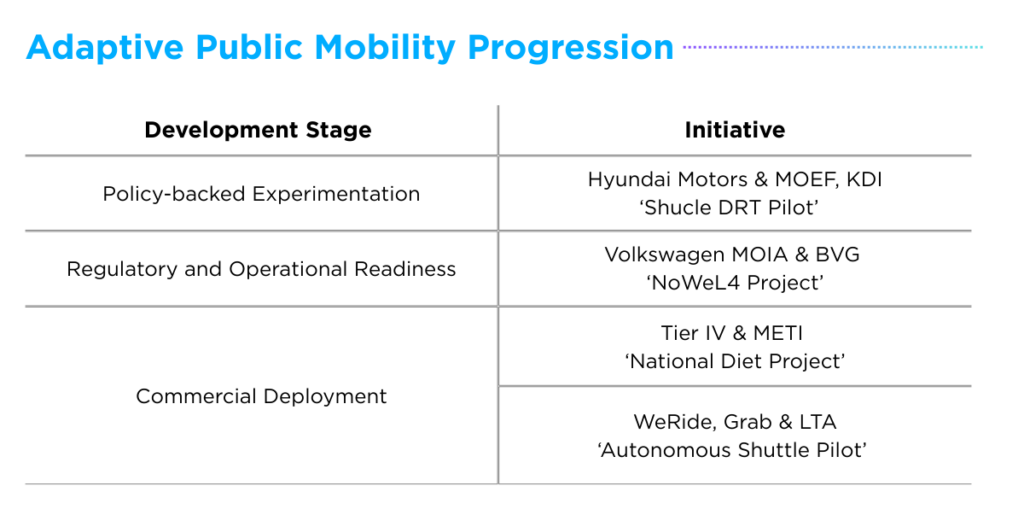
Despite regional and strategic variations, the four cases trace a clear progression in how adaptive public mobility is evolving through public-private collaboration.
The ‘Shucle DRT Pilot’ demonstrates how bilateral innovation programs can initiate policy-backed experiments that connect governance with technology. Building on this foundation, both the ‘NoWel4 Project’ and ‘National Diet Project’ exemplify how coordinated public initiatives are advancing regulatory and operational readiness for autonomous urban transit. Finally, the ‘Autonomous Shuttle’ pilot highlights the transition from controlled testing to commercial deployment, illustrating how proven technologies can scale into real-world, revenue-generating services.
Together, they pursue the same overarching goal: to enhance accessibility, efficiency and adaptability within public transportation systems and highlight a global shifttoward an adaptive mobilityframework.
Future of Connected Mobility
As cities worldwide adopt adaptive mobility frameworks, their success increasingly depends on secure, interoperable collaboration between public and private stakeholders. Ensuring seamless communication among vehicles, infrastructure, and digital platforms requires standardized protocols, trusted data exchange and end-to-end cybersecurity. Without these foundations, the integration of connected and autonomous mobility remains incomplete.
AUTOCRYPT plays a defining role in enabling this transformation. In particular, AutoCrypt® MOVE™ (Learn More) is one such solution which shows our capabilities into the mobility platform domain. Designed for demand-responsive transport (DRT) and other emerging mobility services, AutoCrypt® MOVE™ enables operators to plan, deploy and manage secure, data-driven mobility platforms tailored to diverse needs.
By combining our proven expertise in fleet management, data analytics, and security integration, AUTOCRYPT supports both public transit operators and private mobility providers in establishing reliable and adaptive services.
With expertise spanning digital key management, V2X communication, cybersecurity testing and compliance consulting, AUTOCRYPT provides the technologies and guidance that help stakeholders operate securely within complex mobility environments. By embedding safety and interoperability into every layer of mobility infrastructure, AUTOCRYPT helps build a trusted, scalable, future-ready ecosystem which benefits both public and private partnerships.
With the advent of software-defined vehicles, the concept of the car key hasevolved from a physicaldevice into a digital access system seamlessly connected to the driver’s smartphone. Through smartphone-based digital keys, drivers can lock, unlock, start vehicles and even share access to their vehicles — all through a single intuitive mobile experience.
As vehicles become increasingly connected, the need for robust security grows alongside the convenience these systems provide. Every interaction between the smartphone, vehicle and backend must occur within a trusted, interoperable ecosystem that protects against unauthorized access and data compromise. This article explores the core components of a secure Digital Key Ecosystem and highlights the measures and technologies that enable safe, seamless, and scalable vehicle access.
I. Secure Digital Key System Architecture
Digital key solutions operate within a complex ecosystem connecting multiple systems and communication layers. From user registration to daily vehicle operation and key revocation, every stage requires security embedded by design to ensure the digital key performs safely, reliably and seamlessly.
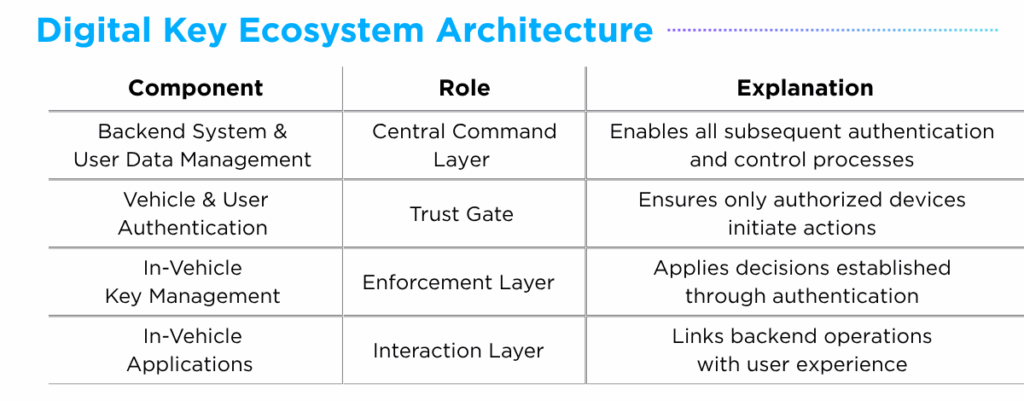
At the foundation of this ecosystem lies the Backend System & User Data Management layer, which links user accounts, vehicles and mobile devices through centralized control. This layer manages user registration, key issuance and access permissions across multiple vehicles, synchronizing updates between the mobile app and vehicle in real time. By continuously managing backend events such as invitations, temporary credentials and revocations, it ensures that digital key services remain scalable, interoperable and responsive to every user action.
The next layer, Vehicle and User Authentication, safeguards trust between the user’s smartphone and the vehicle before any operation takes place. Through certificate-based authentication and encrypted communication, this layer verifies that both the driver and vehicle are legitimate participants in each interaction. As the core of identity verification, it ensures that every connection within the ecosystem begins from a trusted foundation, maintaining cybersecurity from the very first handshake.
Beyond authentication, the In-Vehicle Key Management layer embeds protection directly within the vehicle. Every vehicle interaction is validated at the hardware level, controlling how digital keys are stored, verified and applied to vehicle systems. Whether online or offline, this layer preserves key confidentiality and enforces access rights while integrating proximity-based protection to prevent relay or spoofing attacks. In doing so, it enables continuous safeguarding of digital credentials throughout their active use.
Finally, the In-Vehicle Applications layer provides the user-friendly interface that connects security with convenience. Hosting in-vehicle infotainment (IVI) and head-unit control (HCP) applications, it allows drivers to view key status, manage profiles and control access settings. By coordinating commands such as unlock, start and key sharing with backend systems in real-time, this layer ensures user interaction and consistent connectivity across all digital key features — whether for individuals or fleets.
II. End-to-end Digital Key Solution
Digital key systems function as a unified ecosystem, with each component — backend, authentication, in-vehicle systems, applications — continuously exchanging data and trust signals. These interactions form a closed feedback loop, where every vehicle operation and user action is reported back to the backend for synchronization and validation. Building an effective digital key solution requires recognizing how these layers interact through a system-level approach.
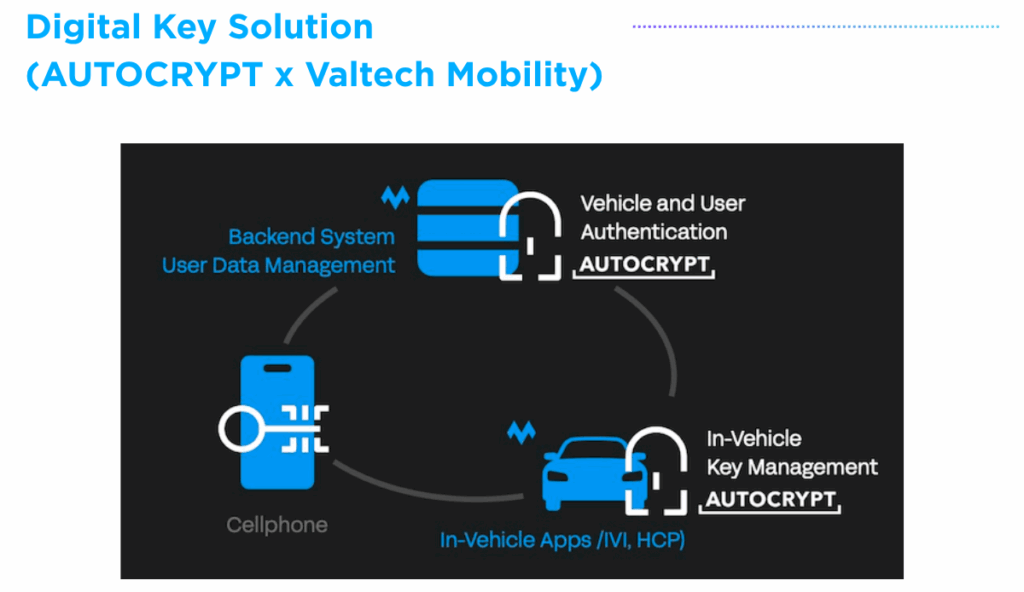
A prime example of such an approach is the co-developed Digital Key Solution by AUTOCRYPT and Valtech Mobility, unveiled at IAA Mobility 2025. Designed around interconnection and interoperability, the joint solution demonstrates how a unified architecture can deliver a secure, reliable, and scalable digital key experience built on shared standards and complementary expertise.
The solution’s architecture enables continuous communication between the backend, authentication layer, in-vehicle key management and smartphone interface:
Backend System & User Data Management: Data synchronization and multi-user access are managed in alignment with Car Connectivity Consortium (CCC) guidelines.
Vehicle & User Authentication: Real-time authentication between smartphone, vehicle and cloud is reinforced with Ultra-Wideband (UWB) proximity verification for precise, relay-resistant access control.
In-Vehicle Key Management: Key credentials are handled within secure hardware environments, ensuring both performance and protection.
In-Vehicle Applications: Access and control are provided through an intuitive smartphone interface, integrating convenience with end-to-end security.
This solution delivers clear advantages for bothOEMs and users. For OEMs, its CCC-compliant, globally interoperable solution framework ensures readiness for standardized deployment. The solution’spurpose-builtcloudsystemwithopenAPIs enables fast, cost-efficient integration while remaining scalable and adaptable across different vehicle models and mobility platforms. Over time, this flexibility also creates new revenueopportunitiesthroughpremiumdigitalkey and connectedservices.
For users, the digital key can be accessed seamlessly through their smartphone, combining convenience with robust protection. Secure authentication and UWB-based proximity-based verification safeguard against unauthorized access, while controlled key sharing allows owners to grant temporary access to family members, friends, or service providers — without compromising privacy or data integrity.
III. Conclusion
This article explored how the digital key ecosystem connects multiple systems and communication layers – from backend platforms to in-vehicle components and user applications – to deliver an end-to-end vehicle access experience. The jointly developed solution by AUTOCRYPT and Valtech Mobility GmbH exemplifies how an integrated approach can achieve security, scalability and user accessibility in unision.
Building on its proven expertise in Digital Key solutions, AUTOCRYPT continues to develop tailored digital infrastructure and foster strong technology synergies with global partners to advance the future of connected mobility.