Have a look at how automotive technology has evolved throughout the history of automobiles.
(Accessibility version below)
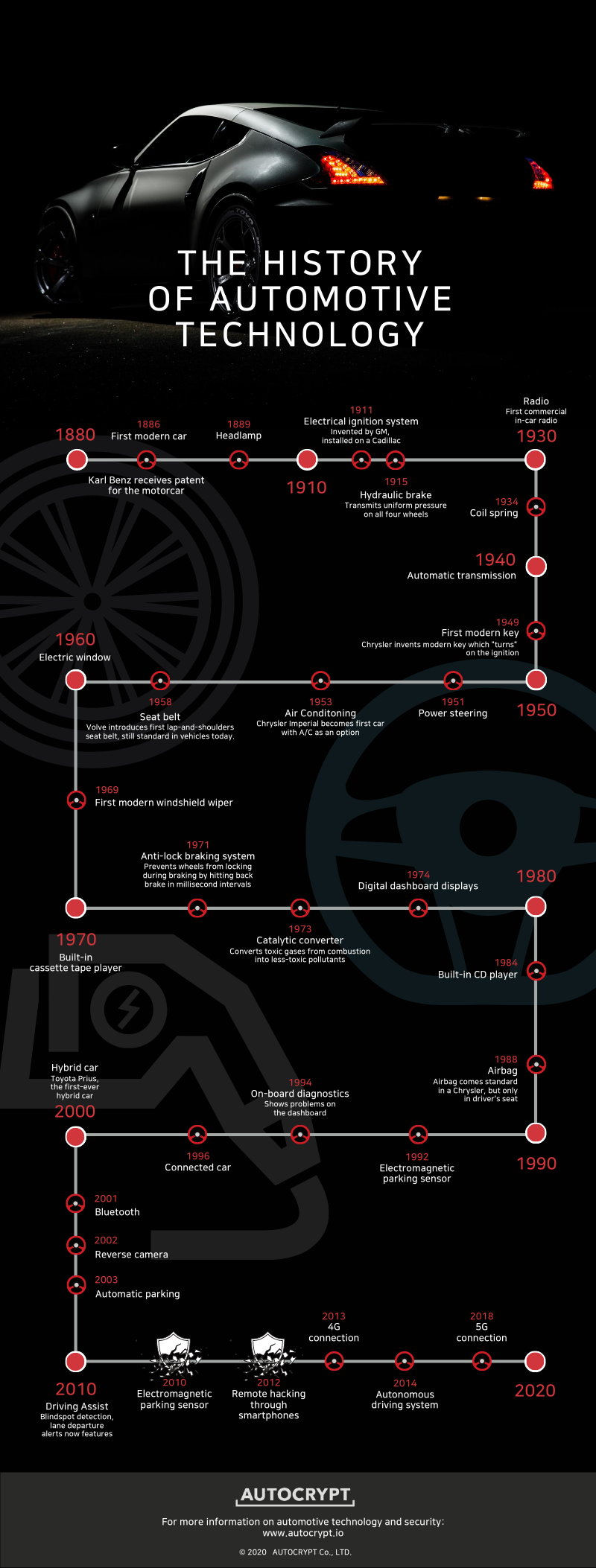
The History of Automotive Technology
1886 – The first modern car / Karl Benz receives patent for the motorcar
1889 – Headlamp
1911 – Electrical ignition system is invented by GM and installed on a Cadillac
1915 – Hydraulic brake. A hydraulic brake transmits uniform pressure on all four wheels
1930 – The first commercial in-car radio
1934 – Coil spring
1940 – Automatic transmission
1949 – The first modern key is invented by Chrysler, which allows the key to “turn” on the ignition
1951 – Power steering
1953 – Chrysler Imperial becomes the first car with air conditioning as an option
1958 – Volvo introduces the first lap-and-shoulders seat belt, which is still standard in vehicles today
1969 – First modern windshield wiper
1970 – First built-in cassette tape player
1971 – First anti-lock braking system which prevents wheels from locking during braking, by hitting back brake in millisecond intervals
1973 – Catalytic converter converts toxic gases from combustion into less-toxic pollutants
1974 – Digital dashboard displays
1984 – First built-in CD player
1988 – Airbag begins to come standard in a Chrysler, but only in the driver’s seat
1992 – Electromagnetic parking sensor
1994 – On-board diagnostics show problems on the dashboard
1996 – First connected car
2000 – First hybrid car with Toyota Prius
2001 – Bluetooth
2002 – Reverse camera
2003 – Automatic parking
2010 – Driving assist detects blindspots, lane departure alerts
2012 – Remote hacking through smartphones
2013 – 4G connection
2014 – Autonomous driving systems
2018 – 5G connection